Why do some designers build lasting careers while others fade out?
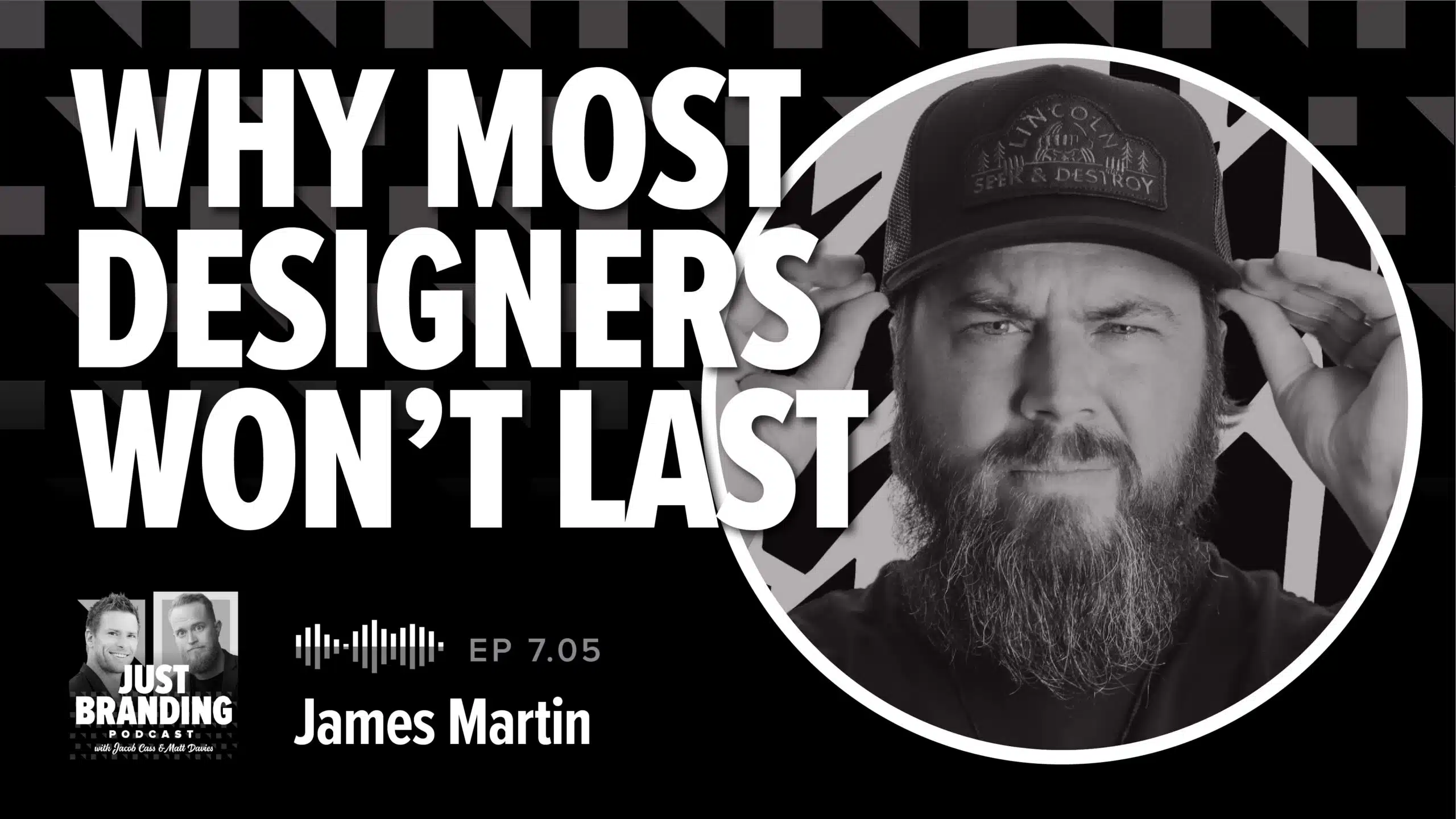
In this episode of JUST Branding, we sit down with James Martin, founder of Made by James, to unpack what really sustains creative success over time and what quietly destroys it.
While many designers are chasing visibility, speed, and short-term attention, James makes the case for something deeper: reputation, craft, taste, and care.
We explore why reputation is more valuable than hype, why craft still matters in a world of AI and instant design tools, and why taste remains one of the most overlooked advantages in creative work.
James also shares why motivation is unreliable, why care is a far stronger driver of long-term creative growth, and how designers can think more clearly about their role in an industry being reshaped by automation and DIY branding tools.
This conversation is not just about design. It is about longevity. What makes people trust your work. What makes your work worth paying for. And what separates designers who build real careers from those who get lost chasing noise.
We also get into the hidden cost of DIY branding, when founders should do it themselves versus bring in a professional, and what becomes more valuable for creatives as AI lowers the barrier to entry.
If you are a designer, strategist, or founder trying to build something with depth, credibility, and staying power, this one is for you.
In this episode, we discuss:
- Why many designers confuse visibility with credibility
- What actually builds a strong creative reputation
- Whether craft is being lost in the age of speed and automation
- Why taste is still a serious competitive advantage
- The difference between motivation and care
- The hidden cost of DIY branding
- What AI makes easier, and what it can never replace
Tune in for sharp, honest conversation about what still matters in creative work, and why the designers who last are rarely the ones chasing the fastest win.
Listen Here
- Listen on Apple Podcasts
- Listen on Spotify
- Watch on YouTube
- Listen below
Love the show? Please review us on Apple.
Play Now
Watch on YouTube
Learn Brand Strategy
Brand Master Secrets helps you become a brand strategist and earn specialist fees. And in my opinion, this is the most comprehensive brand strategy course on the market.
The course gave me all the techniques and processes and more importantly… all the systems and tools I needed to build brand strategies for my clients.
This is the consolidated “fast-track” version to becoming a brand strategist.
I wholeheartedly endorse this course for any designer who wants to become a brand strategist and earn specialist fees.
Check out the 15-minute video about the course, which lays out exactly what you get in the Brand Master Secrets.
Transcript
Hello and welcome to JUST Branding. Today’s guest is James Martin, a designer, author and educator who has built a recognized reputation not through the work he produces, but through the principles he stands for.
James is the founder of Made by James, a studio known for bold, distinctive logo marks and identity work that has been shared across the design world for years. He’s also recently become an Affinity Creative Partner, working closely with the Affinity team to advocate for independent creative tools, and a partner at Lincoln Design Co., if you can see his lovely hat right now, where he collaborates on brand and identity projects for some of the world’s biggest brands.
James is also the author of Made by James, the Honest Guide to Creativity and Logo Design. And he’s currently working on a new book that continues exploring themes around creativity, reputation, and the long game of creative work. Recently, James has been writing and speaking about a few ideas that have really caught our attention.
And that’s the importance of reputation over hype, why craft still matters in a world obsessed with speed and automation and how taste actually develops. And more recently, the difference between motivation and care and why care is a thing that sustains creative work over time. We’re also going to talk about the rise of do-it-yourself tools and AI, if we can fit it in, and when these tools actually empower creativity and when they actually quietly create bigger brand problems down the line. So James, welcome to the show. Glad to have you here. Thank you very much.
Thank you so much for that incredible, incredible, what is it? An intro, I suppose, isn’t it?
It was a monologue, wasn’t it, of success?
It wasn’t it, golly, I was like, maybe you should write my eulogy when I die. That was brilliant. We’re all going to die. This is going to happen. It’s a pleasure to be here so late in the UK with you, Jacob and you Matt. Thank you so much for inviting me. So what are we chatting about? Stuff, I suppose.
Stuff, yes. Good old chinwag, as you like to say. I love that.
Hey, chinwag is, do you know what? That little word chinwag, every time I say it to somebody who isn’t a Brit, they’re like, what on earth is a chinwag? Do you know what I mean? It’s like talking, isn’t it? Do you know what I mean? Not many people get it, but yeah, I love it. I love it.
So yeah, lots of fun things to talk about.
It’s a great place to start, isn’t it? And I’m going to apologize to all of your viewers. It’s all right for Matt, because Matt’s probably not going to do a lot of talking, but I’m very tired. It’s 10 p.m. Jacob’s kind of organized this at a time, which is really nice for him and his lovely hot country, John.
He often does that, James, right? Now the listeners are getting a little peek behind the curtain.
Yeah, he’s such a diva, isn’t he? Although I’m the one who sounds like a diva, because I’m the one complaining. What a wonderful thing to talk about. I think an incredibly powerful thing to understand and leverage for probably a lot of the listeners, but also we’ve all been in the brand game long enough to hear different opinions of how to build brand, what a brand is, and there’s always very variations on that theme. I don’t think anybody’s ever wrong, are there? Some people are wrong, but not most of the time. Everybody’s got, it’s all about point of view, perspective, isn’t it? I think that’s really important, especially from creative people who perspectives are an incredibly powerful thing, and when it comes to connecting dots and all the rest of it. Yeah, for me, a brand, I like to view it through the lens of reputation, it being a recognizable reputation, and the reason I personally like to do that for myself and my clients, because I think it allows me to have a little bit more control, whereas feelings, I think, are a bit more difficult to understand, but I think when you can break down a reputation, and I break it down into four key areas of like integrity, competence, narrative and community, I think it’s a little bit easier to comprehend and control and bring some sort of like edge to some boundary to. For me, the main reason why we build a reputation, which happens over a long time, but I’m sure we’re going to get into craft and mastery and all the things further down the line. I personally believe we build it to reduce the commercial risk of people giving us money. Do you know what I mean? The reason we build a good reputation is so we become a safer commercial opportunity for our clients. So we do it to reduce friction. And yeah, I think reputation is truly the key. Sorry, my brain is ticking. It’s starting to move now. It’s starting to move. It’s the key to opportunity. Do you know what I mean? I think that’s what we all want. Do you know what I mean? It doesn’t matter to what degree. The reason we all build brands is to essentially make money and support ourselves. That’s the reason why these things are manufactured. These brands are manufactured. That is the sole reason I believe is to make money. Now, you can do that in good ways and bad ways, obviously. I think we do it to support our families, otherwise, it’s something different. So, yeah, opportunity is the big one.
Can I ask you a quick question?
Yeah, please do. It stops me from f***ing talking all the time.
No, not at all. I’m loving it. It’s helpful to just see how you frame things and see things. On that note, you mentioned four component parts of how you break up a reputation. Love to dive into those just briefly in terms of how you talked about boundaries. Talk to me about community and then the other ones.
Yeah, I’m not that clever, Matt. Do you know what I mean? Whenever I’m trying to think of things, I always try and break them down in a way that makes them probably a little bit more understandable for people. I believe my job is to help my clients understand. We spend a lot of time speaking to other designers and we understand our weird f***ing words. But not many other people do. So I think it’s always good to break down things into some sort of digestible chunks. So yeah, the first one is obviously integrity. What I essentially mean by that is, do your actions match the things that you’re doing? Do you know what I mean? Your values and all the rest of it. So I think that’s a really important one. And then there’s competence. Are we competent at what we do? Can we walk the walk and talk the talk? I think that’s very important. Narrative, is there a consistent story that is being told about you and that you are telling? And then the community, which is the fourth one, is who is in your corner. We’re not talking about audience or reach here. We’re talking about the people who are in rooms when you’re not there saying your name. Do you know what I mean? So I think if you’re working very hard on nurturing that community and you’re working hard on being very consistent with a narrative and you live up to your integrity and your values consistently and you are continuously working on your craft and your competence consistently. And that’s the really important thing is the consistency of all four of those areas. And look, if you rated yourself out of one to ten in all of those, like nobody’s ever going to be ten. Do you know what I mean? But I like to break it down in those kind of simple forms purely because it allows me to know where I need to do some work or where my clients potentially need to do some work and I can steer. So many people are generally quite good at, depending on who you’re speaking to, obviously, I think competence is always generally a fairly strong one. People sometimes know what they do. Some people don’t. That’s a different matter again. I don’t want to get too much into the negative ninny stuff, but I think that’s always quite a strong one. And then I think integrity is a bit of a wobble, but it’s usually the bottom two that are the ones that really start to compound. When you have that consistent narrative and your community is kind of, like I said, bringing in opportunities for you without you even being there. But that only happens again for a lot of patience, for a lot of consistency, for a lot of repetition, for a lot of consistency and all the rest of it. Yeah, those are very important. But I know if you work on them for a long time, yes, we evolve and we make mistakes and we are human and we’re a little bit messy. Usually, if you’re working very hard on those four things, things do start to compound. And I think that’s the big problem that we see in today’s world generally, is that I don’t think people are giving themselves enough time for the compounding to happen. Yeah, for sure. There’s another thing, I’m going to talk to you about all the things. There’s this another thing I have called the Deeds Model. So it’s like D-E-E-D-S. And I think it’s, I say your deeds dictate your reputation. And this is really handy for anybody just starting out, or anybody who’s in a little bit of a plateau, or anybody who’s trying to just figure out what’s next, or what they’re doing, or where they’re going wrong. And I think a quick breakdown of that is, the first D is decide what you want to be known for. Do you know what I mean? I think that’s a really important thing. You both know as brand people, when it comes to positioning, it comes to messaging, it comes to your people. You need to know what you want to be known for, so you can then kind of position yourself in the right way. The first E is educate yourself in alignment to becoming that person. And that never stops. That is a continuous, and that’s where craft, mastery, all of these things, you never reach mastery, it’s impossible, but the education is such an important thing for that competence. Then you’ve got to evidence the process of becoming that person and through doing the thing. So that could be anything from getting testimonials from your clients, like building your own IP, your own frameworks, like showing your work and all this kind of stuff. But the thing with evidence is that not everybody is going to have access to evidence. It’s impossible for everybody to have access to all the things you’ve ever done. So what you’ve then got to do is you’ve got to demonstrate the proof, which is the next D, and demonstrate the proof in the right spaces. Because there’s a big difference between evidence and proof. Do you know what I mean? So there might be, and this is a slight struggle when people don’t do enough marketing, I think, is that they’ve got a lot of evidence. They might have been in the industry for 30 years and they’ve done so all this great work. But if nobody knows about it, if it’s never turned into proof, then it doesn’t exist essentially. And then the final S is stay in the game long enough for it to compound. And that was the reason why I wanted to mention that Deeds model. Because I think it’s like if anybody’s ever in a little bit of a funk or like worried about what to do next, I think that Deeds model, your Deeds dictate your reputation. I think it all starts with having a really good understanding of what you do, who you do it for. Because then the rest of the stuff seemingly fits into place. It gives you your azimuth, you know what I mean? You know where you’re going.
Love that. Love that. Yeah, I think that consistency and I love that. Stay in the game, right?
I think it’s tough to stay in the game, doesn’t it?
It is. I know like we’re in a very fast world. And I think we think it’s not working after three weeks, right? That’s it. These things, people look at Jacob and myself and probably you as well, James, for sure. And they look at us and think, Oh, I’ll do that. I’ll do the things. And they do it for two weeks. And then that’s it. And then like, Oh, it didn’t work. You’re like, hold on. This has taken us years, like literally decades to build, I guess, the expertise, the reputation. To your point, James, to be able to command the rooms that we do and speak to the, and have the honor of speaking to the people that we speak to. This takes a long time, folks. You’ve got to stick at it. I love all of that. One of the things I think is fascinating, I coach people from time to time, and I always say to them, look, you’ve got to show yourself in action and demonstrate your value. They’re my two principles, and it’s lovely to virtually see pretty much. That’s what you’ve got there. You’ve got the evidence and the demonstrate, but you’ve added much more on, which is even better than my two.
I mean, you’ve come to your understanding through from time and patience in the game, and yeah, I think it’s such a really interesting world that you know how important perception is, for example, especially in branding, and the reason we, I suppose, curate or manufacture a brand is to have some sort of control of that perception, do you know what I mean, especially if we’re working with clients, but perception can also be faked, do you know what I mean? You can have bugger all evidence, you can have no competence, zero integrity, and you can now build a huge following by just playing the game, do you know what I mean? Creating this perception of somebody who is competent and has integrity, we don’t even know if they’re real humans anymore. But that’s the thing, so the perception game is actually quite easy but is also flawed. You see a lot of it, don’t you? Maybe you see even crazy things like people literally copying somebody’s exact website and then putting their face on it. Do you know what I mean? Literally, that was CJ, wasn’t it? Did you hear that, Matt? Yeah.
No, what’s that? Talk to me about that.
Tell the story, Jacob.
Yeah, so CJ Cawley, another great speaker. We had a summit and he’s a designer, a big following and someone literally copied his whole site and used AI to change his photos and just swap the face. So his whole website copied his work and even the photos in his studio just changed the name with AI and the face, which is crazy.
Yeah, it is crazy.
You must have been fuming.
They did something cheeky and he actually put a photo on his contact page with his brand name on his own website, on CJ’s website. So like when you roll over one of the photos, it says his name on it.
Anyway, but the thing is with that particular game, so what that chap is trying to do is trying to increase his perception as somebody who knows. Look at all this body of work, not mine. Look at my great studio. Look how creative I am, not mine. Look at my words, not mine. Do you know what I mean? Perception, perception, perception. Now, what happens when a client finds him? How does that person execute that style of work? Is that person competent enough? This is the big disconnect with that kind of game. You will lose.
Yeah, you will definitely lose.
Yeah, you would lose. Now, this is why I get quite upset and a little bit like, antsy about the kind of personal brand world and how like the way to fix your problems is to just get loads of reach and loads of visibility and you’ll be rich. Do you know what I mean? Because that, there’s no point having all that visibility and that reach if you’ve got like a jar full of friction. Like this guy, like he’s going to maybe get some eyes on him. He’s maybe going to get a client coming to him, but he’s not going to be able to, he hasn’t got the competence to work with the client. So it’s just all that’s going to happen is it’s just going to fall flat on his face is actually going to be a detriment to his brand because he’s going to get bad ratings. He’s going to, and then he’s probably just going to go on to the next thing and copy Jacob’s website or Matt’s website next sale. He’ll try and win here. He’ll fail. He’ll try and move again. And what you’re doing there is you’re just going backwards. You’re not progressing. You’re not growing. You’re not doing anything. So this is the really interesting game. I think, when people talk about reach and perception, because I don’t think evidence can be faked. I don’t think proof can. You can fake evidence if you steal it again. But again, if you can’t back it up, do you know what I mean? Like, what’s the game? What’s the end game? And I think this is, I don’t know, in the order we’re going in. Do you know what I mean with our conversation here?
Well, I think that’s a good bridge to craft, right? Because if we’re building design of the case of visibility.
I was going to go somewhere else, Jacob. But you go there. That’s great. Let’s go there.
Craft, taste.
Yeah.
What were you going to go with?
I’m with you, mate. It’s your world. I just live in it. Let’s go.
I think it’s a good segue because you can’t fake the craft. If once someone comes to you and then you try to execute on it, you can’t do it, then that’s where the friction is. We have AI design tools, templates, like instant logos now. How do you feel about all of that? Are the designers getting better? Are they lazier? What’s your…
Never going to speak for another designer. I don’t think that’s my place. But like for me, I think… Like I said, I always try and control what I can control. I can’t control the tech. There’s no way this guy can stop anything from happening. Do you know what I mean? None of us have that power. I think there’s six people on the planet that have all the power right now. We’re just living in their world. Do you know what I mean? So, look, I can’t change the tech, but I can control where I put my energy and I can control where I place effort. I, again, if I think through the lens of reputation and how I know opportunities work, good opportunities happen when you are competent. And competence generally comes from a craft that you’ve decided to be good at. Do you know what I mean? Yes, you can, I would say I’m pretty competent at like brand design, visual identity. I believe I have an interesting mind when it comes to thinking and creativity. But I write 4,000, 5,000 words every single week on the subject. I read about it. I explore it. I spend a lot of time with it. And I have done that for just like you. I’ve been in the industry now for 20 years. And I think when we talk about crafts, and I think you mentioned the word discipline as well, like for 20 years, it hasn’t been easy. It’s actually still incredibly difficult today. Do you know what I mean? It gets more and more. There’s different types of difficulty, but it’s still not easy. Like this whole idea that you get to a point and everything just becomes easy.
There’s always another level, right? You get to one mountain.
Yeah, I think there’s always another level. I think there’s always, especially if you are striving towards a mastery of craft and you know, that’s never attainable, but that’s also the most exciting thing about it. For me, I know I’m never going to be perfect. And that’s something that I embrace quite a lot. And I’ve been wrong a lot along the way. I just hope that I’m more confident. Like, I know if I’m confident and I know what I’m talking about, and I do that by reading and relearning and rethinking. I know that when I have conversations like this, I’m able to do so with other clever people, because I believe I do have a good understanding of the subjects we’re talking about. If you put me on a podcast about f***ing cookery or like gardening, I would probably have to fake my evidence and make s*** up just to try and be interesting. Do you know what I mean? But I think in this particular room, I have the right to be here to talk with you two about this.
That would be quite amusing, to be honest. To be fair, you have got a lot of plants in the background there.
Yeah, but there is also a famous chef called James Martin as well.
Oh, is that right?
Have you never f***ing had a James Martin?
I probably have.
Where have you been sleeping under a rock?
I’m not a culinary master chef either.
No, I can tell that Matt, I can tell that about you. So yeah, I think the discipline things are really important thing, but the discipline takes a lot of control as well because, like I said, it is sometimes quite boring life and work. It is not always exciting. I think that’s what a lot of people, when it does get tough, they pivot, tweak, change, move on. Whereas I believe the people that go through those times and maybe like evolve or change, and I think there’s, God, it’s such an interesting topic with all the tech, and we’re going to probably talk about DIY tech, and we’re going to talk about AI and stuff, and it’s got everybody in a little bit of panic, a little bit of a pickle, John, because it’s really difficult. I was very blessed to speak at the D&AD in London a couple of weeks ago about this subject, and it was the topic that I wanted to bring up was this whole, that the subject was, is creativity dead or alive? And the question I wanted to raise in the room was, it’s not really whether creativity is dead or alive, it’s what happens to creativity when people are continuously told they’re about to be replaced. Do you know what I mean? Because that doesn’t leave enough room or space for creativity to thrive or to happen. But it’s really, it is really interesting, because I spend a lot of time in different networks of different industries. And like the design creative industry is like on the whole very anti, understandably. Music industry, the same. A lot of those kind of creative arts, film, the same. But you go into other spaces. Do you know what I mean? And it’s generally quite positive. It’s a really interesting thing, because I do believe there is this element of identity that we tie to our work and our practice that we feel is being taken from us a little bit as well. We’ll probably go on some more stuff like that.
It’s interesting you mentioned that. I don’t know what your thoughts are, but for me, like I used to run creative teams in the past and I always used to think the number one killer of creativity is fear, right? Because if somebody is scared to put a bit of themselves out there, it could come from anywhere. They might be scared of rejection, scared of failure, scared of being humiliated, whatever it might be. It could be, as you say, fear of putting something out there and then them losing their jobs the next day because there’s an AI that can do it better. All of that is going to not produce the best, the best creative work. So I just think you’re right there and I think in the creative field, I’m like you, James, I spend a lot of time in other part of very boring industries where they think AI is phenomenal. I’m doing a project at the moment with a client in the medical industry and they see AI as basically saving lives. Now, you can’t say that’s a bad ambition for them to have in that space. It’s one of those things, but I do always think, what are your thoughts on AI, if I can say so James, as a sort of through creative, like, how do you view it? Are you afraid of said AI or like, how do you confront that?
I think what my blessing and my curse is that I don’t try and overthink too much. That’s it.
What’s your gut say?
Yeah. So first, let’s go back onto the panic and the fear before we go on to this. So I think that’s a really interesting thing.
If you’re serious about mastering branding and building a thriving, creative business, the Brand Builders Alliance is for you. Inside, you’ll get live master classes, mentorship from our eight resident coaches, a stacked resource vault, and a global network of brand builders who actually get it. If you’re done winging it alone and are ready to scale with structure, support and serious momentum, head over to joinbba.com and get on the wait list. That’s joinbba.com.
I think it’s really important to remember that we’re wired this way as well. So we have this like tiny little thing in our brain called the amygdala. It’s this tiny little almond shape thing like in the back of our head somewhere. I think it is in our brain and it’s got one job and it is basically to scan for risk, react really quickly and keep us alive. Do you know what I mean? So everybody’s amygdala is firing right now. So if people ever think that they’re alone in the panic and the fear, they’re not. That’s just your brain doing its job. That’s how you’re wired. And the problem is, we are continuously fed, your job’s going, your job’s going, your job’s going. So everybody’s just going, do you know what I mean? Right now. And that is very normal. But back onto the kind of AI conversation. Look, I don’t honestly believe that even the people in control of the AI know what’s going to happen. I honestly don’t believe anybody has a f*****g clue what sort of Pandora’s box we’ve opened here, which should scare the life out of us all. Firstly, I don’t potentially think this is just a job thing. I think this is like a- like it could be cataclysmic. That’s a big word for 11 PM almost, but it could be really s**t bad. Look, before this was happening, AI and all the rest of it, I also knew that I was going to die eventually. We’re all going to die eventually. That’s always been incredibly motivating to me, because I know my time is finite, so I try and do everything I can do while I’m here, while I’ve got choice. I think at the moment, we still have choice. For me, the choice is to either take action, pivot, try, do, start something, build something, or don’t. I think we have that choice. For me, when we talk about motivation, we go on to that. I think the tools have the potential to amplify what’s already there. If you’re lazy, it will make you lazier. Do you know what I mean? If you’re driven, it will give you more drive. If you’re curious, it can give you the power to really push your curiosity. So I think right now, that’s how I look at it. I use it every day. I learnt quite early on that it was quite important to… I heard somebody say, I can’t remember who it was, like, try it in everything and figure out what it helps with and figure out what it doesn’t help with. And I found out a f*** ton of stuff it doesn’t help with. Any sort of execute, like, my style execution right now, it’s getting better, don’t get me wrong. But, like, for me right now, like, logos, identities, creativity, concept generation, it’s still average. But it’s, like, if it’s a weird thing to think about. But if you took it as, like, a people say, it’s not that creative, but I would probably suggest that it might be more creative than 90% of the world. Do you know what I mean? Like, I do believe it is. If you took the average, the mean, it probably beats a lot of people. Do you know what I mean? We know how good it is at math, and I can see how quickly it’s moving. And you’ve seen all the Will Smith tests and the spaghetti tests and all that kind of. It’s pretty mind boggling from 2023 or 2024, whenever, I think it was 2023. Like the speed over the last three years and which it’s evolved. Now, like I said, we don’t know what’s coming. Do they have enough power, computing power? Do they have enough electricity? Do they have a… It’s fucking shit for the planet. I think for every good thing it could possibly do, cure, I think there’ll be 10 bad things it does, unfortunately. But again, very focused on James, which feels selfish, but I think this is a good time to be selfish. And if I could give any guidance to anybody right now, it would be it’s never been easier to build the thing, make the thing or start the thing. It’s never been easier. And I think creative people in general have the opportunity to rule the world. Do you know what I mean? If I think about creative people, we’ve got very good people skills generally, very good at problem solving. We have creativity, we have empathy, all of these things, which I believe make pretty good leaders. Do you know what I mean? And if we used the creativity and we got our own ideas out of our head and into the world, like I said, which has never been easier before than it has been, do you know what I mean? I would go and build the thing. I would go and do the thing. I think it’s time to take control.
The thing is, Joe James, as you alluded to earlier, designers see themselves as designers. Do you know what I mean?
I think that’s an overgeneralization. I think some don’t.
Maybe. I’d certainly, just talking for myself back in the day, I very much saw my identity as Matt, the designer. That was my thing. It did take me quite a journey to break out of that self-created box. Now, I’m something completely different. In fact, I hardly ever reference myself as a designer, even though the stuff I do now very much is designed just in different fields. The same principles are being applied. I just design businesses with business leaders now, rather than designing the graphic design that used to promote those. If that makes sense. It is really interesting to think about that. Anyway, that was just my personal.
No, I’m not going to say that you’re wrong either. I don’t think you are wrong, but I think we all get in our own way sometimes. We talk about the old amygdala again, like, it’s trying to keep us safe. So, change, comfort zones, risk. These are not things that, like, the majority of people on the planet are happy to do. People would much prefer to stay in a steady job than follow their dreams, because they’re worried about bits and pieces, like bills. And that’s rightly so, do you know what I mean? I don’t like to… I can’t predict the future, but I do believe… I do believe that there will be a point soon where we won’t have the choice, potentially. So, right now, I think we still have… You’ve got to have a little bit of agency, you’ve got to have a little bit of get up and go, and you’ve got to try and do something. Because the problem I do see, and I hate talking down about stuff, because I know how difficult it is for lots of people. But there’s just a lot of talk about how bad it is, rather than… And then the people I see talk about how bad it is, I don’t see them doing anything. Do you know what I mean? And that’s always the thing for me. Like I say, I could never live a day in anybody else’s shoes or anything like that, so I don’t really know what’s going on in the background. But I speak to a lot of creatives and a lot of designers and who are out of work or lost their job or whatever. And I speak to them about what they’re doing, like how they promote themselves, how they market themselves, have they done their website, like what are they doing? And they’ve done nothing. And I’m like, this is tough. It’s going to be tough if there isn’t that motivation to try and change the scenario. But yeah, it’s a toughie, isn’t it? The beautiful thing about it is that if it gets to what they suggest it might get to, we’re all f***ed up. So it’s not just designers.
James, so our friend James Bernard, he recently shared a video reel, was like AI versus me as a designer. And that had some backlash, but in his community, he posted about it saying that he actually did lose a job to AI because the creative director wanted to go that direction. So it’s actually happened behind the scenes. And this is from an established person with a lot of following and a lot of leads and everything.
But that, maybe he should just be a better designer. Do you know what I mean? I’m only joking, JB, but I hear it all the time. Do you know what I mean? I was speaking to a friend of mine only Wednesday, yesterday, and he said he had a web project and his job was to design and then basically code out and build out the website and help this client with this particular thing and halfway through, they did it in AI by themselves, the design and the layout in one of the AI agent tools.
Yeah, and you can do it in a couple of keystrokes, right?
Yeah, this is the thing and it will become a lot of strategists. I know a lot of designers, so like James’ scenario is, and I love him for everything he does. We’re good friends and he’s a very brave and honest dude and it’s good to start people to start seeing this because it’s going to happen more and more. There’s a lot of people who wouldn’t be brave enough to tell anybody about that. So yeah, Matt’s got like some crazy bug flying around in this thing.
I was trying to stay calm.
Is that some sort of AI drone? But yeah, I mean, it’s a really interesting thing and I know it’s happening because that isn’t the first time. James’ story, Mr. Barnard’s story is not an isolated moment. That is happening more and more. I hear a lot.
There was a time in history though, right? When somebody saw a printing press for the first time and all the sign painters were like, oh, wow, do you know what I mean?
Yeah, I think this is different though, isn’t it?
It is, but is it? Like, it’s different in the sense of the technology and the way this stuff reasons and thinks. But in terms of production, in terms of new possibilities, it’s, I guess it’s of a similar step change from pre-industrial revolution to industrial revolution, in my mind, anyway.
Yeah, I mean, I think it’s slightly different in the fact that usually when you replace a job, a new job is there for you. I, if this AGI happens in 2027 or whenever they believe it might happen, humans won’t need work.
Yeah, it’s bizarre. What will we do all day? We’ll just jump on podcasts like this, talking about the good old days when we actually did stuff.
Talk s*** all day. But I think, I do think it’s slightly different in that respect because I don’t think there’ll be more jobs generated.
No.
Because I don’t think, unless we are all very funny but scary meme, not me, but it was this parody and it was a really fat Elon Musk and a really fat Bezos and who would like Sam Altman, do you know what I mean? They’re really fat and unfit. Basically, what they had done is they’d started like humans. There was these big rooms of really stacked men and women, like just cycling because they were the ones who were generating all the energy for the time. That was their job. Their job was just to get pumped because that was all that was left. Do you know what I mean? So look, like I said at the beginning, we don’t know what’s going to happen. We’re only, I believe the narrative around your job is going to be replaced, humans are going to be replaced. We’re going to save world debt. We’re going to cure the world. The only reason these narratives are happening is because the people who are saying them need people to keep giving them money. Do you know what I mean? If they said, we haven’t quite figured it out yet, they’re in trouble, aren’t they? Yeah, we’ll figure it out. We’ll figure it out.
So what’s your thoughts on this as like an antidote? So moving from like a task doer to more of a strategic partner with clients, working alongside them to build a brand versus just execute on say a logo or website, which is increasingly getting more outsourced.
Yeah, I think I suppose the question is like when the technology makes execution easier, where does the value go? I would say the easy answer is probably judgment and discernment, taste. Those are probably the things that we still by the multitude of experiences that we’ve all had individually. We see the world slightly differently from each other. So like I said, we like through the craft and through the kind of the path to mastery or whatever you want to call it, you’ve basically absorbed so much work, you’ve consumed a lot of work, you’ve done a lot of work and you’ve educated yourself and you studied a lot of work. So you start to know what’s good, what’s bad, what’s right, what’s wrong. So we talk, people talk about what going upstream, don’t they? So the thinking is the thing that’s going to be of value, which again, I think is probably true, probably an obvious answer.
So taste is something you talk about quite a bit and technical skills you can teach, right? But taste is a bit harder to define because it’s based on experience. But how do creatives develop taste over time?
I think what I just said, really, I suppose, I think you have to curate it, do you know what I mean? So like when we talk about the deeds model again, then the education, that when I think of education, I think of that as like taste enabling, do you know what I mean? So you’re constantly like doing the thing, learning about the thing, seeing what other people do, with the thing, you’re potentially bringing in different perspectives from other industries to help you do the thing, your experiences, your travel, different cultures, like different movies, different books, do you know what I mean? All of the things come together to form taste. I suppose you can add in other bits and pieces to that. But again, like these things, they don’t just happen overnight, unfortunately, and they can’t be rushed. There’s a lot of shortcuts, hacks. Do this in 10 days, make 100 million tomorrow by following my prompt, do you know what I mean? Like the, like I don’t know, I don’t know how we have got here. But like I said, the things that I think will endure and always have are, there’s actually, I reread a book called Drive recently by Daniel H. Pink and that talks about motivation. I know we’ve talked about that. And he talks about these, this one here. He talks about this. Oh yeah, I think that one. Yeah, it’s a classic. Yeah.
Yeah, it’s a great book.
Yeah, I love it. He talks about the two types of motivation in there and he talks about intrinsic and extrinsic motivation. And there’s a few books that I’ll read again and again, because as the world changes, as I change, I find different things and I connect different dots. And that’s always been a nice little kind of creativity hat for me. And when we talk about taste and patience and mastery and all of these things, he talks about, I think he calls it, what is it? It’s like AMP, I think. It’s like autonomy, mastery and purpose are the three things that he feels that drive people, continuously drive people for like intrinsically motivated people. So autonomy being like the feeling that you are choosing, you have agency over the decision that you’re doing, rather than simply responding to a moment. Do you know what I mean? And then you’ve got mastery, which is that kind of slow, incredibly frustrating humanness. But what you’re trying to do is you really want to get better at something, so because it matters to you. Do you know what I mean? For all of us here, I would like to think that we really care about our craft. So the kind of striving to mastery to some degree is a part of the pain. Do you know what I mean? And then there’s obviously…
Because we know that we’re heading somewhere and… Well, I hope so, yeah.
Yeah, there is that.
Yeah.
Yeah, it’s last one’s purpose, isn’t it? That kind of idea.
Yes, it is, yeah. And that’s just generally the kind of effort that’s probably connecting to something larger than yourself. So there has to be a reason to get up in the morning, isn’t there? But the whole intrinsic and extrinsic things really interesting, I think, because he classifies extrinsic motivation as things like the fear and the money and the kind of things that are almost like incentives and they’re really important, do you know what I mean? But they only ever work well early on because the novelty of the extrinsic motivations fades. And obviously when novelty fades, the only thing that matters is whether you give a shit and you see this all the time, like when people get jobs and they make good money, like that incentive, do you know what I mean? Works to a point and then they go, f***ing hell, this is f***ing f***ing good, do you know what I mean? That’s the thing because they’re not intrinsically motivated to push through and to keep going. The purpose, the craft, the mastery, do you know what I mean? Like the extrinsic motivations, they fade after a while. When we look at the AI back on that, and you think about what are people motivated by now? Saving time, saving money, speed, do you know what I mean? Extrinsic motivators. But what’s going to happen in two to three years’ time when they’re bored of doing it themselves and their brand might have moved quicker, but nobody gives a sh** because it looks f***** crap, and it sounds f***** crap, and it is f***** crap because also we know the importance of humans and culture and value, especially from U2’s perspective as brand builders. Where’s the culture? What happens when the AI takes over and nobody gives a sh**? What happens to the brands? And also thinking about big picture s**t here, what happens when we all lose our jobs, we got no money to pay for these brands that are all using AI? Do you know what I mean? How does that loop get closed? Do you know what I mean? I don’t know if anybody’s fought this all the way through. Do you know what I mean?
I don’t think they have. No.
But again, it’s a really interesting thing. But yeah, taste again, like taste is just something that is, it just comes through experience and through doing. And I think there’s, I think you both know Stefan Sagmeister. He has this thing called, he has this thing called, I think he calls it a Sagmeister actually, or it’s called a Sagmeister. And basically he’ll work for two to three years with his clients, then he’ll take a year off. And he’ll just say, I’m taking a year off. And he’ll just go traveling and he’ll go and absorb different culture. He’ll do different things, push his creativity and then he’ll come back. But when he comes back after a year, he’s got different perspectives. He’s developed his taste. He’s brought in new nuance and theories and all the rest of it. He can probably get away with it because he’s probably really rich and he’s really clever. You know what I mean? But it’s not always easy for all of us to do that. But again, like choice, he chooses to do that. Yes, he might not make that much money. Probably that year, but he’s probably done all right the few years before and he knows when he comes back, he’ll be able to use those experiences and that taste that he’s been curating to go again. Do you know what I mean? And his clients are probably like, give me some of that brand new Sagmeister. Whatever that is, give me that. I want you day one when you’re back from holiday, son. Do you know what I mean? That’s probably what people are saying.
That’s his strategy.
Yeah.
Awesome. Something we didn’t talk about was like care and I think that’s the through line between all of this. It’s like when you care for your craft and like building tastes and the motivation comes because you care.
Yeah. I think probably care is incredibly important, but again, it probably potentially has to be like internal and external. I suppose what I mean by that, it probably I care for myself, but I think I have to care about something bigger than myself to keep going. That’s probably that intrinsic motivation, isn’t it? As well. So you’ve got to, because ultimately, once the novelty wears off, you’ve just got to give a s*** about something, haven’t you? Which is basically care. I think it’s, do you know what? I’m really not a big lover of the whole follow your purpose malarkey. I think it’s a dangerous thing. Like when people say authentic personal branding, I just want to buff them on the nose and say, shush, don’t be an idiot. But I think you do have to, when I think about follow your purpose, I think a purpose is something that comes through care, and comes through patience, and comes through trying. I think I’ve always liked helping people, but it was never a purpose. It’s only just something that’s been nurtured, and the education side of me, and wanting to help other people. But that came over a long time. The purpose almost found me through that continuous action. So I think a purpose is almost like a bit of a reward for patience. So the idea of following it is tough. But I do believe, it’s much easier for me to go through the good weeks, the bad days, the bad months, the good mumps, you know what I mean? Like the wobble that life is, because I care. Do you know what I mean? I care about getting better. I care about supporting my family. I care about supporting my community. Do you know what I mean? I care about trying to do the right thing. I care about staying up at f***ing 10 o’clock in the evening to talk to some Australian dude and some guy from Wales. Do you know what I mean? I think there has to be, you have to have this kind of intrinsic motivation. Otherwise, it is a very stop-start relationship with a career and life. It’s like you get to a point, the money, extrinsic values fade off and you go, okay, what’s next? Do something else, get excited again. And then you go, do you know what I mean? Constantly like this. Yeah, I think it’s an interesting thing. Yeah, but you got to give a sh**, haven’t you? Otherwise, what’s the point? Do you know what I mean? You two wouldn’t do this podcast if you didn’t give a sh**. Do you know what I mean? Whether that’s about meeting new people, getting new perspectives, developing your own taste, your own knowledge, talking to people, being able to put this stuff out into the world so others have access to it. There’s a huge amount of care there because it takes a lot of energy. You have to stay up late like me, Matt. Do you know what I mean?
Not that we’re better or anything, James.
Not that we’re better. I’m the only diva here. It’s all good.
But do you know what I mean?
You care.
Yeah, we do.
And I see that when I, if you break it down, it’s really, I don’t like to, like I said, be a mood hoover about stuff, but the people that I see.
Mood hoover.
That’s great. The people who I see doing some really amazing things, they’ve got something to care about. Do you know what I mean? They really care. Now, their life might be not always fine and dandy, but I think when you’ve got something a little bit bigger than yourself, it can be, it can be quite a powerful thing. So, yeah.
All right, Matt, I think we’ve covered the gamut, reputation, taste, craft, AI, how you need to get to bed.
Yeah, I’ve got more time if you want me to carry on. Wait, did she say that, Jacob? The problem is now, f***ing Jacob Cass, I’m wide awake now, I’m not gonna be able to sleep for two hours. He’s buzzing. I’m buzzing, absolutely flying. It’s like being on E again, do you know what I mean?
F***ing great.
All right, where should we go with this? We do have some rapid fire questions, if you’re up for them.
Okay.
Yeah, why not?
We didn’t talk about DIY tools, did we? I suppose we did a bit with AI.
Yeah, we could open that up, I just thought we talked about AI, but yeah, we can talk about.
Yeah, I’ll tell you what, f*** it, let’s rapid fire, son. I think we’ve covered a good amount there.
Actually, you know what, the story came to mind, when you shared something in your sub-sec recently about building your shelf and it was wobbly, and you come back and look at it, and it’s always a reminder of you took a shortcut. So, I think maybe it is worth a conversation around do-it-yourself branding.
Oh, it’s the wonky shelf. So, yeah, the story of my wonky shelves. Yeah, this goes back to that extrinsic motivation. So, I believe I can paint my office and I can believe I can put up shelves and pictures. So, the extrinsic motivation for that is I’m going to save time, I can get it done right now and it will save me money. But the problem is, if I look closely, it’s a shockingly bad job. Like nothing is straight. This is why I have to cover it with stickers and there’s holes in the wall over here where I’ve just done such a shockingly bad job and not used the right drill or the right thing in the wall, the right fixings. So now what I do is I walk past that every day and I’m disappointed with myself and my life. Do you know what I mean? It makes me a little bit sadder. And what I should have done is I should have just paid somebody to do it properly and then I wouldn’t have this problem. So now I’ve got to live with all this wonky in my life. And that is what I think is going to happen at scale with AI, that everybody is taking the shortcut, everybody’s doing the quick fix, everybody is speedy, get it done, get it up, don’t hire somebody who knows what they’re doing. So we’re going to be in a world where there is just wonky shelves at scale. Do you know what I mean? All over the place. And I do believe there will be a point where it goes back. I think it’s too novel right now. I think the idea of doing it, trying it, using it is too exciting. But that novelty will wear off. And I think people will be where they are two, three years ago.
So when it comes to branding, rather than shelves, do it yourself branding.
Yeah. Is it helping? Yeah. So yeah, do you know what I love? I think the ability to build, make, create is incredible. I love the fact that everybody has access. And I don’t think, I don’t think that’s necessarily the problem. I think the problem is that everybody’s skipping the thinking part. Do you know what I mean? So they’re just creating stuff for the sake of creating it, rather than thinking about the thing that they’re creating. Do you know what I mean? So I think if there was some element of slowing down, why am I doing this? Who is this for? Do you know what I mean? Then I don’t think it’d be a problem. But we also have to remember that our industry are probably a little bit snobby about that. Do you know what I mean? Maybe in some cases, where at least like many people have worked incredibly hard to have the taste, to know that something doesn’t look that good. But I also think that designers are the only ones that actually care. Do you know what I mean? The client doesn’t give up two hoops. Because the other thing is like, when I think of it, I’m not going to ask you, because it’s quite a personal question, but I’d imagine to hire you Jacob or to hire you Matt is not. Something is that accessible for 90 to 95 percent of the world. So what do they do? Do they just not bother and just sit at home and knit or something? I don’t know. What do they get to do? And I think if you look at the likes of Canva and AI and the kind of democratization of all these things, like Canva’s got, I’m obviously going to, I’m quite on board with Canva. I’m on physically on the board with Canva or the Design Advisory Board. But so I’m not going to, this isn’t like a preachy thing. But my point is that there’s 270 million people every single month using Canva. 270 million a month. Do you know what I mean? Do you know how many designs a day there is? It’s a crazy amount. A crazy, a billion designs a day. Do you know what I mean?
A lot of wonky shelves out there.
Yes, but who cares?
Who cares?
They don’t.
So why should we?
Do you know what I mean?
I think there has to be, when we talk about control and we talk about the things that we are in control of and the things we’re not. You’re not in control of all the wonky shelves out there. You’re just in control of whether you put up a wonky shelf. Do you know what I mean? I think there’s a lot of energy spent worrying about other people’s wonky shelves. You see any new identity, new brand be put on the Internet and you see every **** on the Internet have an opinion. Golly, get on with it. Do you know what I mean? What are you doing? I don’t give a **** wherever you think it’s for leadership. It’s ****. You weren’t in the room. Do you know what I mean? It’s not up to you. I don’t care. Do you know what I mean? Sorry.
What are the hidden costs if you are doing it yourself?
It’s like with anything, the hidden costs are, if you don’t know what you’re doing and you’re doing it yourself, you have the potential to waste time, to potentially the shortcut you might be making early on could cost you further down the line. But again, I’m a big believer in, you kind of figure out once it’s out in the world, don’t you, a little bit. I think as a creative bunch of people, we are classic overthinkers. We think everything has to be perfect before it even gets to see a human eye. Do you know what I mean? And that’s why 98% of it never gets seen by anybody and stays in a shelf. Do you know what I mean? A wonky shelf or drawer, whatever. But yeah, so I think when stuff is out in the world, you have the ability to test and validate quite early. I think with every, I think there’s always a trade-off. You think of all of the big brands today that nobody knew about when they started, they just started and probably did a little bit of DIY and just tried and started and did it again and learned and probably failed a fair bit and then figured it out because they were doing the thing and because they started the thing and they were doing the thing and somebody started giving them money, they got confidence. So once you got confidence, you go, hang on a minute, maybe I can do this. Do you know what I mean? So I think it’s, do you know what I mean? I would personally say, do you know, it’s better to DIY yourself, save some money early on. Depending on what budget, depending on the scale of business, depending on the objectives and the goals, I think for anybody who is starting out, like I would, why not have a little go yourself? Like, why not just scrappy the sh** out of it, get it out in the world and just try and sell it once, get some feedback, validate it, make it better, try and sell it again. Do you know what I mean? Like, why not? That’s the perfect world for DIY, I think, because there’s a lot of people who put a lot of bucks down very early on, before they’ve even told anybody about the idea. They just hope that people are gonna buy it. Do you know what I mean? I’ve had so many stories of people who dropped thousands and thousands and thousands on identity and on websites and on strategy before they’ve even asked if anybody would like the thing or the product or the service that they’re about to just chuck all that money into. And you’re just like, and like why, nothing against strategists, but why would I pay a strategist to find that out? Do you know what I mean? I can do a little bit of legwork myself. Do you know what I mean? Just to go and speak to a human and another human, just to get enough of an inkling. Now I think big agencies, good strategists are incredibly important for people at the right stage of their business. Incredibly important when it comes to dialing in, scaling, growth or whatever it is. But for a lot of people, right at the beginning, I don’t have to go.
So to round this out, just one last question before rapid fire, talking about reputation again, but what advice would you give designers or creatives entering the industry right now? They’re feeling overwhelmed with how everything is going by the tools, AI, all the competition. What would you give advice? What advice would you give?
Read.
Read what?
Everything.
Everything.
Yeah, I think I heard a stat. I don’t know whether it’s true, but the people who read a lot generally end up in the top 5% of their industry. I wish I had read and read a lot of different things, like all over the place. There are books. This is amazing to me. There is books, thousands of them, billions of them, millions of them. I don’t know. There’s a lot of books out there with people who are really good at what they do, and they put it in a book for you to read, and you can do that. I find that fascinating, and it’s my favorite thing. Do you know what I mean? I’m struggling with this, or I’m struggling with that, or I want to learn how to do that. I can go and invest in myself. I can go and spend seven quid, or like 10 bucks on a book full of knowledge and then I can take action on it. That’s the big problem. I don’t think enough people take action on stuff. Honestly, it sounds like such a boring thing, but I know if you read a lot, and we talk about, it gives you so many things. You have to be fairly patient to read a book. You have to stick at it. You have to try and finish shit books, and you’ll go through a lot of shit books that sometimes the way it’s written is a little bit tough, and maybe you just don’t get on with it. I know friends who will listen to books on 1.7 speed, and I’m like, golly. I get into their car and it’s like I don’t know what they take it in. But I do believe that is such a hack. But again, if we go back to the deeds model, decide what you want to be known for and educate yourself in alignment with that person. So before you just go and read all sorts of twatty Harry Potter or whatever it is, do you know what I mean? Decide what you want to be known for and then what are the books that I need to read that are going to help me become that person?
Early in your career, like I’m just looking back at mine, you don’t necessarily know what you want to be known for. So like how do you decide that?
That’s a great question. I think you’ve got to decide something. So you decided that you wanted to be in design, I presume, or in some sort of creative industry, and then by being in that creative industry and the discipline that you had of staying in there, you then decided that you wanted to go into more visual identity, then you decided that you wanted to go into strategy, then you decided that you want to do the other things. Because you’ve constantly be making a decision. Cool.
Well, thank you, Reid. And now ready for rapid fire. We’ll wrap this up.
Oh, golly. We should have done this first when my brain was working. If these are questions, I’m not answering them, by the way, as well.
That’s not an option.
Okay, I have to ask them. All right. All right.
Question one. Question one. What is the brand?
A recognizable reputation. All right.
One habit that improve your craft the most.
Going to bed early.
One book a new designer should pick up and read.
This is a tough one, actually. It’s not quick fire, is it?
I got him. I got him on questions.
There’s a lot of the courage to be disliked. All right.
One mistake designers make earlier in their career.
I think they’re really good when they’re not. Brutal. We’ve all done it. Do you know what I mean? Yeah.
I still think I’m good.
But the ego, I believe early on, you know where you are. It’s about year two or three after you’ve had a few clients, you’re like, I’m the f**king dog’s b**ch, and then very quickly you realize you’re not the dog’s b**ch. Yeah. That’s true.
One thing designers should stop doing immediately.
Slamming rebrands online on LinkedIn that they were not involved in for likes.
I thought you were going to say Dixit logos. Yeah.
Dixit logos. Is that what you said?
Yeah.
I love Dixit logos.
First thing that designers should do when they pick up a new project.
Smile and be really nice to their client because first impressions are incredibly important. It’s called the halo effect. If you have a very good first impression with your client, that first call is full of energy. Because of the halo effect, they will naturally believe that everything else that follows is also going to be really good. First impressions are incredibly important.
What separates good designers from great designers? Time.
Nice. I like it. A one-word answer to wrap up with. It’s like a mic drop moment, like time. That’s all I got.
One final one.
It’s still the last one. Forget that, scrap that.
There is one final one. This will be tricky. If you could only choose one, reputation, craft, or taste, what matters most?
It’s a contradictory question because you can’t have a reputation if you have nothing to build a reputation around. But to answer your stupid question, I would, I think reputation is probably the most underrated word for all of us. Do you know what I mean? But you can have a good reputation, a bad reputation. It’s important that you have a strong, good reputation. Because if you’ve got the other one, those opportunities ain’t coming, son. So yeah, reputation for me as somebody who is good at his craft and has all the other things.
Thank you, Matt. Appreciate you answering our stupid questions. Where can people find you, your work, follow what you’re doing next?
I would, I’ve never been very good at answering this question because I never really know what the answer is. Just I’m around on the internet. Do you know what I mean?
madebyjames.com, yeah.
madebyjames.com. Yeah. Yeah, they’re madebyjames.com. Like I’m a big believer in people will find me if they need me.
And I’m pretty easy for them. James Martin Chef is going to get a few new followers.
Yeah, just don’t type in James Martin because he definitely appears more on Google than I do right now. Yeah, madebyjames.com. Just type in madebyjames.com. You can’t lose, son.
There’s only one James Martin that this show knows unless you. So thanks so much, James, for coming on. We really appreciate you coming out that time. I know our audience would have appreciated your thinking as well. So thank you. And thanks for all you do in the community at large.
Appreciate that. It’s been a pleasure, chaps. Thank you so much.