Adobe Creative Cloud, with its advanced features and extensive ecosystem, has supported numerous film studios, publishers, and design agencies for several decades. With flagship applications like Photoshop and Illustrator and AI-driven workflows, Adobe continues to deliver outstanding results.
Following this high benchmark, in early 2026, Apple introduced its first consolidated subscription for professional creative applications, similar to those offered by Adobe. The Apple Creator Studio bundles videos, music, and design tools into a single platform tightly integrated with Apple hardware.
While Adobe Creative Cloud and Apple Creator Studio both appear to offer comprehensive toolkits for producing modern digital media, each follows a distinct approach. The comparison between them extends beyond features and focuses on collaboration and extensibility to determine their support for long-term professional workflows.
As the creative industry continues to evolve with cloud-based production, remote teamwork, and AI-assisted processes, platform choice has become increasingly strategic.
Professionals are no longer evaluating software solely on toolsets, but on scalability, ecosystem compatibility, and long-term sustainability. We will follow a similar approach to examine how the Adobe Creative Cloud ecosystem differs from Apple Creator Studio, providing a balanced comparison between the two tools to inform a software decision.
Adobe Creative Cloud as a Connected, Cross-Platform Ecosystem
In response to the evolving needs and demands of creative agencies, Adobe Creative Cloud has been structured as a connected ecosystem rather than a collection of standalone applications.
A defining strength of Creative Cloud is its cross-platform availability on both Windows and macOS, enabling agencies, in-house teams, and freelancers to collaborate regardless of device preference. This flexibility reduces hardware dependency and supports mixed IT environments commonly found in professional organizations.
In addition, Adobe’s Creative Cloud Pro plan includes more than 20 applications covering photography, graphic design, publishing, video production, animation, web design, and audio editing. Core applications such as Adobe Photoshop, Adobe Illustrator, and Adobe InDesign form the backbone of many professional creative pipelines. Their native file formats (.PSD, .AI, .INDD) are widely recognized industry standards, enabling consistent file exchange among teams, clients, print vendors, and production partners worldwide.
Perhaps the central pillar of Adobe’s architecture is its cloud-first architecture that connects various applications through the Creative Cloud libraries. It also helps centralize various brand assets, typography, color palettes, and templates so they can be accessed and updated across multiple projects. Assets remain synchronized through user accounts, supporting version consistency and reducing duplication when teams collaborate on shared designs.
Additionally, Adobe offers enterprise deployment options, including centralized license management, user administration, and security controls, making the platform scalable for structured organizations. Complementary services, such as Adobe Fonts (with tens of thousands of typefaces), Adobe Stock (licensed media), and Adobe Acrobat Pro (document workflows), further expand its functionality.
Collectively, these elements position Creative Cloud as an open, scalable system built for professional, cross-team collaboration rather than a device-specific environment.
Apple Creator Studio as a Hardware-First, Vertically Integrated Bundle
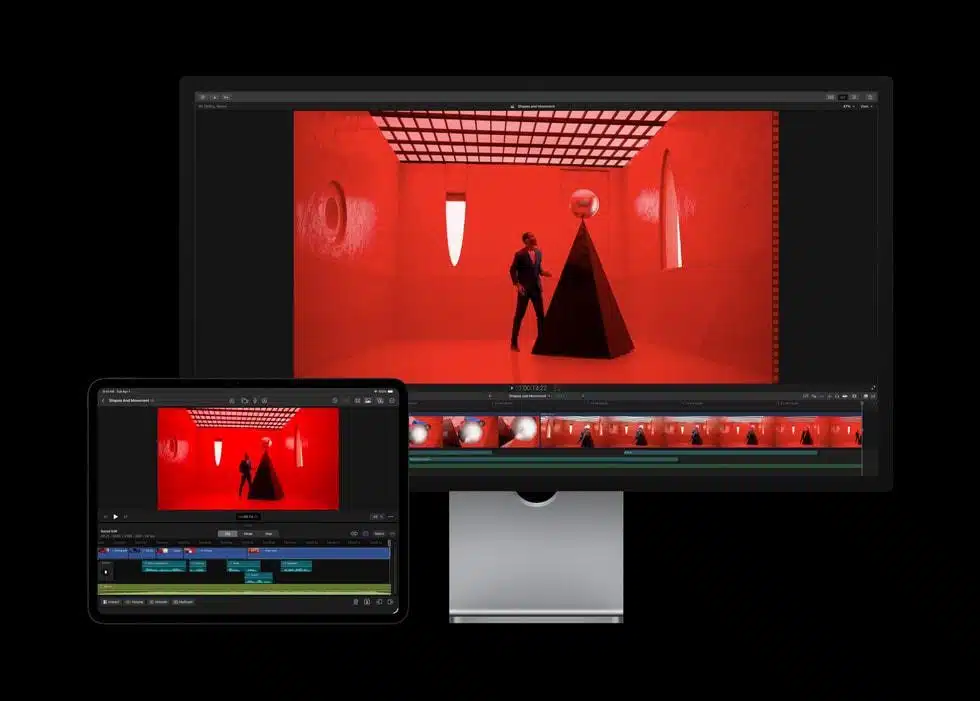
The relatively new Apple Creator Studio follows a fundamentally different strategic approach than Adobe’s Creative Cloud ecosystem. Apple Studio is built around hardware-software vertical integration and prioritizes macOS, with selected functionality also available on iPadOS.
Rather than focusing on cross-platform openness, Apple Creator Studio aims to optimize the performance within its own hardware architecture. The bundle comprises professional-grade applications, including Logic Pro, Final Cut Pro, Motion, Compressor, and Pixelmator Pro. While these tools have a strong reputation in professional creative fields, Apple aims to reduce their aggregate cost by bundling them under a subscription model.
The most defining strategic advantage of Creator Studio lies in the unified workflows across Apple silicon. The use of M-series chips enables the integration of CPU, GPU, and unified memory into a single system-on-a-chip architecture. This delivers efficient rendering, real-time playback, high-resolution editing performance, and optimized power consumption.
Additionally, because Apple is responsible for both the hardware and software layers, its applications can be tuned to support this architecture rather than being generalized across multiple hardware configurations. The bundle also provides access to premium templates and advanced features in Apple’s productivity applications, such as Keynote, Pages, and Freeform, enabling capabilities beyond design.
In strategic terms, Apple Creator Studio functions as a tightly optimized, controlled environment. It prioritizes performance efficiency, device continuity, and streamlined integration within the Apple ecosystem, in contrast to Adobe’s open, cross-platform system.
AI Depth and Workflow Intelligence: Cloud-Scale Automation vs Hardware-Optimized Efficiency
Today, artificial intelligence has become a central component of professional creative workflows. Both Adobe Creative Cloud and Apple Creator Studio address the need for AI integration and workflow automation through distinct approaches.
Adobe Creative Cloud — Cloud-Powered AI and Extensible Workflows
Within the Adobe ecosystem, AI capabilities are primarily powered by Adobe Firefly, which is responsible for generating image, graphics, and text-based content. It also provides the Generative Fill option in Photoshop to intelligently expand or modify images, preserving lighting and perspective through context-aware AI.
Additionally, Premiere Pro provides AI-assisted frame interpolation, scene detection, and auto-caption generation for greater depth. Lastly, After Effects leverages AI for object removal, motion tracking, and rotoscoping, thereby reducing the manual labor and time otherwise required. These AI tools are cloud-supported and integrated with Creative Cloud Libraries, enabling seamless collaboration, version control, and asset sharing across distributed teams and multiple platforms.
Adobe, with its diverse third-party tools and plugin ecosystem, also promises broad extensibility and workflow customisation across graphics, video, audio, and publishing. Studios and professional teams can deploy custom automation scripts, specialized VFX pipelines, and advanced color-grading tools. All these demonstrate Adobe’s focus on a scalable, professional-grade ecosystem that combines generative AI with deep cross-software integration.

Apple Creator Studio — Device-Level AI and Hardware Optimization
Apple Creator Studio emphasises the integration of AI at the device level, thereby contributing to hardware-optimised efficiency. For starters, Final Cut Pro comes with AI-assisted tools for scene removal, voice isolation, object tracking, and smart conforming, thanks to the M-series Neural Engine. These features prioritize speed, energy efficiency, and real-time performance over large-scale cloud collaboration, such as Adobe’s.
Similarly, Logic Pro uses AI-driven mastering and session player features to automatically generate bass, drum, and keyboard parts based on musical context and chord progression. Productivity apps such as Keynote, Pages, Numbers, and Freeform also include AI-assisted features, including Magic Fill, intelligent layout adjustments, and slide design suggestions, that enhance creative workflows without requiring cloud processing.

Adobe VS Apple Comparative Summary
In essence, Apple aims to enable highly optimized local AI embedding within the Apple ecosystem, promising seamless performance on Mac and iPad hardware. This differs greatly from the Adobe AI tools designed for professional extensibility and cross-platform collaboration.
Both approaches meet modern AI demands, but they are designed around different user needs and workflow priorities, reflecting the broader positioning of each platform in professional creative industries.
As a result, Adobe is ideally suited for large teams and enterprises that require collaborative, extensible workflows.
In contrast, Apple targets individual creators and small studios that benefit from performance-optimized, device-integrated AI tools.
Collaboration Depth and Asset Continuity: Cloud-First Teamwork vs Device-Centric Workflow
Effective collaboration and seamless asset continuity are crucial in modern creative workflows, especially when working on complex projects with distributed teams. Adobe and Apple both provide reliable mechanisms for synchronizing these assets and enabling teamwork, but at different levels of scope and scalability.
Adobe Creative Cloud — Cloud-First Collaboration
As noted earlier, Adobe Creative Cloud is built on a cloud-native architecture that emphasizes real-time, cross-device collaboration. Creative Cloud Libraries play a vital role in this regard by storing shared assets such as logos, templates, and colors and ensuring consistency of all design elements across various applications, including Photoshop, Illustrator, and Premiere Pro.
Apart from helping brands with visual continuity, Adobe also allows users to be granted different role-based permissions between owners, editors, or viewers to maintain control over shared assets. Another standout feature is Adobe’s integration with Frame.io for reviewing, annotating, and version tracking of creative assets. This allows stakeholders to track revisions and leave timeline-accurate comments directly within the Adobe applications.
Furthermore, After Effects and Premiere Pro come with Team Projects that enable editors to work simultaneously on the same timeline, with sequence locking to prevent conflicting edits. Adobe’s Camera to Cloud functionality also supports direct uploading of footage to Creative Cloud for immediate access, editing, and team review.
Lastly, for enterprise users, Creative Cloud offers workplace tools such as Slack, Microsoft Teams, and Jira that provide centralized administrative control, large cloud storage quotas, and metadata tagging. Altogether, Adobe Creative Cloud ensures that asset management and project oversight remain consistent across distributed teams working in large-scale production environments.

Apple Creator Studio — Device-Centric Continuity
Conversely, Apple Creator Studio approaches collaboration from a more device and iCloud-centric perspective. Its infrastructure uses iCloud for file synchronization across Mac, iPad, iPhone, and the web. File and folder sharing is also possible between Apple devices, providing a basic level of asset continuity for individual collaborators.
Meanwhile, productivity apps, including Keynote, Pages, and Numbers, facilitate real-time collaboration between multiple users. The simultaneous editing of shared documents is essential for planning and document-centric workflows, but cannot be extended to high-end multimedia production.
While Apple Creator Studio allows users to store and access creative files from Final Cut Pro, Logic Pro, or Pixelmator Pro via iCloud, it lacks a dedicated collaboration layer, such as Frame.io, to track timeline annotations and advanced version control.
To conclude, Apple’s ecosystem encourages seamless access across personal devices, which is often beneficial for individual creators or small, Apple-exclusive teams. At the same time, iCloud’s collaboration capabilities are limited when working with heterogeneous teams or cross-platform devices.

Features & Pricing Comparison: What You Actually Pay
When evaluating Adobe Creative Cloud vs Apple Creator Studio, the cost structure is not just about subscription price. It reflects infrastructure, hardware dependency, and workflow scale.
Adobe Creative Cloud Pricing (USD)
Individuals
- Creative Cloud All Apps: $69.99 per month on annual plan
- Photoshop single app: $39.99 per month
- Illustrator single app: $39.99 per month
- Premiere Pro single app: $39.99 per month
Get 40-70% off — see our Adobe Discounts article.
Teams
-
Creative Cloud All Apps for Teams: $89.99 per user per month
Get 40-70% off — see our Adobe Discounts article.
Enterprise
-
Custom pricing based on seat count and security requirements
Included in All Apps plan:
- 20+ applications
- 100 GB cloud storage standard
- Adobe Fonts
- Creative Cloud Libraries
- Firefly AI credits
- Frame.io basic integration
Adobe is subscription infrastructure. You are paying for continuous updates, AI expansion, cloud collaboration, and cross platform flexibility across macOS and Windows.
Apple Creator Studio Pricing (USD)
Apple Creator Studio launched in early 2026 as a consolidated bundle.
-
Creator Studio subscription: $12.99 per month or $129 per year
Included:
- Final Cut Pro
- Logic Pro
- Motion
- Compressor
- Pixelmator Pro
- Advanced iWork features
iCloud storage:
-
2 TB plan: $9.99 per month if additional storage is required
However, Creator Studio requires Apple hardware.
MacBook Pro with M-series chip:
Typically $1,999 to $3,499+ depending on configuration.
Adobe runs on both macOS and Windows, which allows lower hardware flexibility. Apple’s ecosystem requires continued investment in Apple silicon devices to maintain performance parity.
Cost Context: Surface Price vs System Cost
Adobe:
- Higher recurring software cost
- Lower hardware restriction
- Designed for team scalability and cross platform environments
Apple:
- Lower software subscription
- Higher hardware lock in
- Optimized for creators fully embedded in Apple ecosystem
If you are a solo creator already running a high end Mac, Apple Creator Studio is financially attractive.
If you operate a cross platform agency with distributed teams, enterprise compliance, and complex handoffs, Adobe’s higher cost aligns with operational depth.
Adobe VS Apple Comparative Summary
In summary, Adobe Creative Cloud provides robust, cloud-first collaboration and asset continuity that scales across large, distributed teams. Additionally, its specialised tools are designed for structured feedback, timeline accuracy, and enterprise control.
Apple Creator Studio, by contrast, emphasizes device continuity and simple cloud sharing, which are well-suited for individuals and small teams fully embedded in Apple hardware. However, Creator Studio lacks the enterprise-oriented collaboration and review workflows essential for complex multimedia production. Both systems reflect their respective design priorities: Adobe emphasizes collaborative scalability, whereas Apple emphasizes integrated device efficiency.
Who Each Platform is Actually Built For
Creative software platforms are designed to target specific audiences and may differ substantially in their suitability for creators, workflow priorities, and collaboration capabilities. The same is true of Adobe Creative Cloud and Apple Creator Studio, each designed to meet the specialised needs of different agencies and creators.
Adobe Creative Cloud: Ideal for Professionals and Teams
- Enterprise & Team Focus: Supports studios and agencies with distributed creative teams through centralized asset management and role-based permissions.
- Cross-Platform Flexibility: Operates on both macOS and Windows devices and supports industry-standard file formats like. AI,. INDD, and PSD.
- Collaboration & AI: Creative Cloud Libraries and frame.io enable cloud-native collaboration while Adobe Firefly, Generative Fill, and other AI features automate repetitive tasks.
- Extensibility: Supports plugins, custom VFX pipelines, automation scripts, and third-party integrations, ensuring adaptability to complex professional workflows.
Apple Creator Studio: Ideal for Individual Creators and Small Teams
- Hardware-Optimized Performance: Tailored for Mac, iPad, and iPhone, leveraging M-series Neural Engine for AI-assisted editing, fast rendering, and energy-efficient performance.
- Local AI & Workflow Efficiency: Final Cut Pro, Logic Pro, and iWork apps provide intelligent automation and smart layout tools with real-time speed and efficiency.
- Limited Team Collaboration: iCloud enables basic file sharing and device synchronisation, insufficient for dealing with structured review workflows and enterprise-grade permissions.
- Best Use Cases: Suited for solo creators, independent filmmakers, musicians, YouTube creators, or small in-house teams looking for high-performance and intuitive tools fully integrated within Apple devices.
Adobe vs Apple Software-to-Software Comparison for Real Creative Work
|
Creative Category |
Adobe Application |
Apple Equivalent |
Relative Depth & Positioning |
|---|---|---|---|
|
Photo Editing & Compositing |
Photoshop |
Pixelmator Pro |
Photoshop offers deeper compositing, Smart Objects, PSD industry standard, and ecosystem integration. Pixelmator Pro is strong for Mac-based editing but less extensible. |
|
Vector Design & Brand Systems |
Illustrator |
No true equivalent |
Illustrator remains the industry standard for logo systems, print production, and scalable vector workflows. Apple bundle lacks a full vector-first replacement. |
|
Publishing & Print Layout |
InDesign |
Pages (Basic) |
InDesign dominates professional publishing, prepress, and enterprise print systems. Pages supports basic layout only. |
|
Video Editing |
Premiere Pro |
Final Cut Pro |
Competitive category. Final Cut excels in Apple hardware optimization. Premiere offers broader cross-platform collaboration and ecosystem integration. |
|
Motion Graphics & VFX |
After Effects |
Motion |
After Effects supports complex VFX pipelines and enterprise animation. Motion is streamlined and optimized but less deep. |
|
Audio Post Production |
Audition |
Logic Pro |
Logic Pro is stronger for music production. Audition integrates more naturally into cross-media Adobe workflows. |
|
AI Integration |
Firefly, Generative Fill, AI automation across apps |
Neural Engine-powered AI features |
Adobe focuses on cloud-scale AI and cross-app workflows. Apple emphasizes device-level performance optimization. |
|
Collaboration Layer |
Creative Cloud Libraries, Frame.io, Team Projects |
iCloud sharing |
Adobe supports structured, enterprise collaboration. Apple offers basic file sync and document collaboration. |
|
Plugin & Extensibility |
Mature third-party ecosystem, scripting, automation |
Smaller ecosystem |
Adobe supports complex pipelines and automation. Apple is more closed and hardware-focused. |
|
Cross-Platform Support |
macOS + Windows |
macOS only |
Adobe supports heterogeneous teams. Apple requires full ecosystem commitment. |
If You Use Photoshop → Pixelmator Pro (Apple Creator Studio)

What Photoshop Is Used For
- High-end retouching
- Compositing
- Smart objects and complex layer stacks
- Generative Fill and AI edits
- PSD client handoffs
Apple Alternative: Pixelmator Pro
Pixelmator Pro covers:
- Layer-based editing
- RAW photo editing
- AI-powered upscaling and background removal
- Color grading tools
- macOS-optimized performance
What Feels Similar
- Layer workflow
- Masking
- Adjustment layers
- Professional exports
What Changes
- No Creative Cloud ecosystem
- No true Smart Object parity
- Limited plugin ecosystem
- PSD compatibility is good but not always perfect
- Less enterprise standardization
Who Can Switch Easily?
Freelancers, content creators, social designers working primarily on Mac.
Who Should Think Twice?
Agencies delivering layered PSDs to clients or collaborating across Windows teams.
If You Use Illustrator → No True Apple Equivalent

Apple Creator Studio does not include a dedicated vector-first application comparable to Illustrator.
Pixelmator Pro includes vector tools, but it is not a full brand-system or print-production vector environment.
What This Means
If logo design, brand systems, and complex vector illustration are core to your workflow, Creator Studio does not replace Illustrator.
Your options:
- Keep Illustrator
- Use a third-party vector app
- Accept limitations in advanced vector workflows
This is one of the most significant structural differences between the ecosystems.
If You Use InDesign → No Publishing Equivalent

Apple Creator Studio does not include a professional multi-page publishing tool comparable to InDesign.
What Pages Can Handle
- Basic layout
- Brochures
- Reports
- Simple books
What It Cannot Support
- Advanced prepress workflows
- GREP automation
- Enterprise publishing systems
- Industry-standard print production pipelines
If publishing is central to your workflow, Adobe remains unmatched.
If You Use Premiere Pro → Final Cut Pro
This is Apple’s strongest competitive territory.
What Premiere Pro Is Used For
- Multi-camera editing
- Agency video production
- Timeline collaboration
- Cross-platform editing
- Integration with After Effects
Apple Equivalent: Final Cut Pro
Final Cut Pro offers:
- Extremely fast rendering on M-series chips
- Magnetic timeline workflow
- AI-assisted scene detection
- Smart conform and object tracking
- Optimized real-time playback
What Feels Similar
- Professional video editing
- Multi-camera support
- Color grading
- Motion graphics integration via Motion
What Changes
- macOS only
- Different timeline philosophy
- Less cross-platform collaboration
- Smaller plugin ecosystem compared to Adobe
Who Can Switch Easily?
Independent filmmakers, YouTubers, and small production teams fully embedded in Apple hardware.
Who Should Think Twice?
Agencies collaborating across Windows systems or relying heavily on After Effects pipelines.
If You Use After Effects → Motion
What After Effects Is Used For
- Motion graphics
- Advanced compositing
- VFX
- Enterprise-level animation pipelines
Apple Equivalent: Motion
Motion offers:
- Real-time motion graphics
- Titles and transitions
- Template creation for Final Cut Pro
What Changes
- Simpler toolset
- Less VFX depth
- Smaller plugin ecosystem
- Not widely adopted in enterprise pipelines
Motion is excellent for fast, optimized titles and broadcast graphics.
After Effects is built for complex production environments.
If You Use Audition → Logic Pro
What Audition Is Used For
- Podcast editing
- Audio cleanup
- Sound design
- Broadcast workflows
Apple Equivalent: Logic Pro
Logic Pro offers:
- Professional recording and mixing
- AI-assisted session players
- Advanced mastering tools
- Deep music production capabilities
Logic is stronger for music production and studio recording.
Audition integrates more naturally into cross-media Adobe workflows.
The Real Creative Divide
Apple Creator Studio Is Strongest In:
- Video editing
- Audio production
- Hardware-optimized performance
- Real-time speed on M-series chips
- Solo creator workflows
Adobe Creative Cloud Is Strongest In:
- Cross-platform flexibility
- Design and publishing depth
- Collaboration and version control
- Mature plugin ecosystem
- Enterprise production pipelines
The Strategic Reality
If your creative work is:
- Video-heavy
- Mac-based
- Individual or small-team focused
- Performance-driven
Apple Creator Studio makes strong sense.
If your workflow involves:
- Brand systems
- Multi-app design pipelines
- Publishing
- Cross-platform collaboration
- Client file handoffs
Adobe remains the more complete professional infrastructure.
Conclusion
Adobe Creative Cloud supports both individual creators and professional teams with cross platform flexibility, scalable collaboration, and extensible workflows. It is built to grow with you, from solo projects to complex production environments.
Apple Creator Studio is optimized for creators working within the Apple ecosystem who prioritize speed and device level simplicity.
Both platforms offer AI assisted tools and streamlined workflows. The difference lies in ecosystem strategy. Apple focuses on integrated device performance, while Adobe delivers a broader, platform agnostic system designed for collaboration and long term scalability.
For creators thinking beyond a single device and planning for sustained growth, Adobe Creative Cloud remains the more versatile and future ready foundation.
Resources:
- Adobe Software List
- Discover Acrobat Studio — Your New AI-Powered Productivity Platform
- How to Use Adobe Firefly to Create AI Art