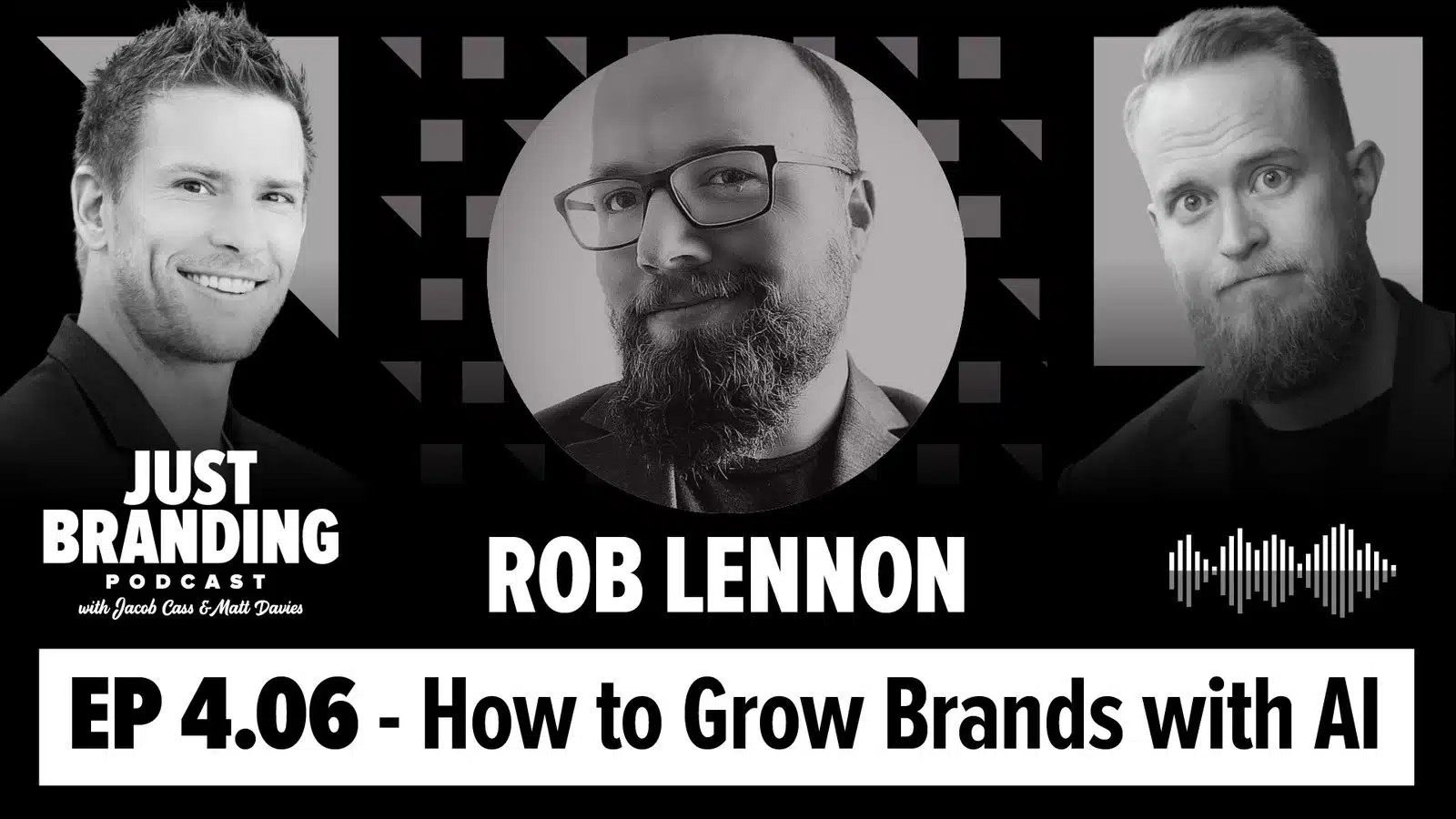
Get ready to revolutionize your branding game with the help of AI!
In this episode of JUST Branding, we are joined by the renowned digital marketing expert and “AI whisperer,” Rob Lennon, who has 45 publications under his belt and a wealth of knowledge and resources around AI, ChatGPT, and prompt craft.
Rob shares actionable insights on how you can leverage AI, particularly ChatGPT, to grow your business. Plus, we dive into the benefits of using AI, such as improved efficiency and personalization, and showcase real-life examples of successful AI integration in brand & marketing efforts.
But that’s not all! Rob also reveals specific tools and techniques that can be used to teach AI to embody your brand’s unique voice, style, and customers. By the end of this episode, you’ll have all the strategies and tools you need to take your brand to the next level with AI.
We also discuss the ethical concerns related to using AI in content and marketing, and explore the potential pitfalls and mistakes that companies should avoid.
Finally, we look towards the future and discuss how AI will continue to shape the world of branding and marketing.
Don’t miss out on this exciting opportunity to learn from the AI whisperer himself and unlock the full potential of AI for your brand.
This summary was written by AI based on the transcript of the episode. How’s that for practicing what you preach!
Listen Here
- Listen on Apple Podcasts
- Listen on Spotify
- Watch on YouTube
- Listen below
Love the show? Please review us on Apple or Stitcher.
Play Now
Watch on Youtube
Show Notes
- Rob Lennon on LinkedIn
- Rob Lennon’s Newsletter
- Mind Meets Machine Podcast
- AI Content Reactor Course
- The Best ChatGPT Prompt Framework
More AI Resources
- AI Business Tools
- Best AI Photo Editors
- ChatGPT Beginners Guide
- How to Make AI Art
- How AI Art is Changing Art & Design
- Artificial Intelligence & Its Impact on the Design Industry
Learn Brand Strategy
Brand Master Secrets helps you become a brand strategist and earn specialist fees. And in my opinion, this is the most comprehensive brand strategy course on the market.
The course gave me all the techniques and processes and more importantly… all the systems and tools I needed to build brand strategies for my clients.
This is the consolidated “fast-track” version to becoming a brand strategist.
I wholeheartedly endorse this course for any designer who wants to become a brand strategist and earn specialist fees.
Check out the 15-minute video about the course, which lays out exactly what you get in the Brand Master Secrets.
Transcript (Auto Generated)
Hello, and welcome to JUST Branding, the only podcast dedicated to helping designers and entrepreneurs grow brands. Here are your hosts, Jacob Cass and Matt Davies.
Hello, and welcome to JUST Branding. Today we have Rob Lennon with us. I connected with Rob early in the year on LinkedIn, as I was deep diving into ChatGPT and AI.
LinkedIn’s algorithm bubbled up Rob’s post and I was hooked on his content. But who is Rob? Well, Rob’s official title on his socials is AI Whisperer.
So, but if you go beyond that, I personally would call Rob a digital marketing expert. He may have some other thoughts on that, but we’ll see. Simply put, he helps businesses grow fast.
He’s a 45 times published author. I’m sure we can get into that, that’s a lot. He knows a thing or two about writing.
So he’s got a course also on AI content. He’s got an AI podcast too, coming out, where the co-host is literally an AI. So that’s super interesting.
He’s got an AI and business strategy newsletter and a ton of resources around ChatGPT and prompt craft. So if you’re new to AI, we can definitely get into all of this. So there’s a lot to learn and a lot to discover.
I’m super happy that Rob accepted to be on JUST Branding today, so he can pick his brains on all things AI. We’re going to discuss how we can use AI, in particular ChatGPT, to help grow our brands. And we’re going to share the benefits and the pitfalls, opportunities and strategies we can start using today.
So welcome to the show, Rob.
Hey guys, so happy to be here.
Awesome. Welcome, Rob. Cool.
Well, how about you give our listeners a little bit of an intro to who you are, your backstory, perhaps how you got into AI.
Yeah. So about 16 years ago, I started my career in startups and spent 12 of those in marketing, and content marketing in particular. And about four years ago, at the same time on the side, I was writing romance novels as a side hustle.
So when I talk about how many books I’ve published, most of them are like their niche romance novels. But at that time, GPT-2, like the first publicly available chat bot, or it wasn’t even a chat bot at the time, came out. And I started to secretly experiment with it.
I didn’t do it publicly because I was embarrassed. People won’t think I’m a writer, they won’t think I’m a content marketer. If I’m using AI, they’ll think everything I’ve created is no good.
So for the past maybe four years or so, I’ve been quietly learning these tools, playing with them, testing them, and it started with me wondering, is this going to take my job or I want to know if this is as good as me or not. At the time, it wasn’t. But eventually, I came to find all these interesting tricks and techniques to use the tools to my advantage.
Then come last November when ChatGPT exploded and everyone was waking up to the technology, I revealed that I had this skill set more publicly, and I had a lot to teach and share. It’s been a wild ride for the last six months or so after that.
Rob, just for the simple people that literally have never used it at all, just explain in simple terms how the interface works, how it works. That would be actually-
Mainly just for Matt, the simple people.
Well, I’ve used it a few times. I will come on to this in a bit, folks. Jacob, you underestimate my AI skill-age.
But no, I was just thinking it would be great to hear from Rob’s perspective, just for listeners perhaps who haven’t engaged at all in it, and perhaps been living under a rock, they don’t understand all this language. Perhaps you could help us just explain in brief terms.
Yeah. We’re going to talk about ChatGPT, but what I’m about to say applies to Bing chat. You end up chatting with Bing.
There’s po.com, which is owned by Quora, and they’ve got some chat bots in there. So you’re starting to see these pop up in a lot of places on the Internet. What it is, we call them large language models, but it’s basically an artificial intelligence.
It’s trained on just as much data as they could give it, mostly crawled from the Internet, from books, Wikipedia, just everywhere, and it somehow infers the relationships between concepts. So when you talk to it, it can understand your language, it can understand meaning, and it can reply and give you the things that you ask for. So you can give it directives or ask it questions, and it will return an answer to you.
What’s amazing about what’s going on now versus a few years ago when I was playing with this stuff is before it was rather simplistic. The content that it would create was very average, uninteresting, mechanical, robotic even. And now the cognitive ability of these things has gotten so good that it actually surpasses human in many areas, not all.
But the output that you can get is remarkable if you know how to do it and what to say. And the interface is like a chat. It’s just like texting.
You talk to it, it talks back.
Well, this is like prompts, right? So you give it a prompt and that’s what prompt craft is. It’s like, how do you write a prompt that’s going to get you a result that’s better than just a generic result?
So as an example, would you want to provide an example? Like you type into a search box like Google and then it comes back with results. So how would that actually work?
What’s maybe like a good prompt versus a bad prompt?
Yeah, prompt is basically just a fancy name for a message that you sent to the AI. And I started going down the, I started calling it prompt craft instead of prompt engineering, because I felt like prompt engineering sounded like inaccessible, like something that regular people couldn’t do. And I wanted it to sound more like, I don’t know, making a collage, like anybody can do this.
So it’s just a text message to the AI. Now, most people, what happens is they start by asking a question, like a one sentence question, basic question, how can I improve my branding? How can I grow my company?
What are some advice for marketing for me? Things like that. That works and you will get an answer, but it will be a very average, non-specific answer.
So the AI is accessing all this knowledge and it has to deduce from just those few words, like what it thinks that you’re trying to do. By the way, this is how most people start with AI. They do something basic.
So if you’ve ever tried AI tools and you’re like, ah, it’s not really very good, you might think back to that experience and go, did you just ask it a basic average question with no context, no additional information, no like that.
It’s your fault, folks. You’re not getting good results, it’s down to you, but not Rob.
This is why I started teaching this, is because I saw people saying this technology is not very good, and I’m like, no guys, this is gonna change the world in the next year. If you can’t tell, like you’re probably asking the wrong questions. So one of the things that I teach is, I call these mega prompts, but you don’t even worry about mega prompts.
They’re just a few pieces of extra information you can give any time you query something to get better results. One of them is you can tell it to act as a persona. Like, so as a marketing expert, talk to me about branding for my startup.
So that as a marketing expert will give the AI a specific domain knowledge to kind of access. Another thing you can do is give it context. Talk to me about branding for my startup, my startup in SaaS productivity software with an audience of Fortune 500 companies or something.
You know, you give it a little bit more information now, more specific, more specific. You could even give it steps. I need to help with my logo redesign.
I need you to evaluate these criteria. You know, you can even start to make it think in a certain way. And you can also ask for the format of the output.
So you can say something like, give me an essay on how to do this or return a bullet point list or be as short and concise as possible or go into as much detail as possible. So all of these things just get a way better response from the AI and it tells you exactly what to do for it.
This is actually how I found you, Rob. You shared like a prompt framework and it was literally this. And I was like, well, this makes so much sense.
As strategists, we have to go deeper into companies. You have to understand the company and the marketplace. You have to understand the output.
So it’s no wonder that these mega prompts or crafted prompts work better when you give it more detail. So as soon as I saw that and I used that structure, like the results were just so much better because like you said, you’re giving it instructions on who to act like. So some favorite ones I use like act like a copywriter or act like a professional marketer and now give me some results in this output.
And it’s been yielded much better results just with like a simple change like that.
I’m usually asked to respond as Yoda or something like that, but Jacob, you take it. I’m kidding. Just quickly, Robert, I just wanted to say to sandwich something in here.
Like the basic stuff can be used is so powerful. Like, so for example, I had a transformation program I’m working on with a customer, right? And we needed some titles for five stages of their transformation program.
And they really loved some of the titles I’d come up with, but others they were less excited about. And it was around the theme of going on a journey, right? So I went into ChatGPT and I was like, right, give me a list of, I can’t remember, of like five steps, the titles of five steps for a typical transformation program around the theme of a nautical journey, right?
And I mean, that’s just a simple one, Rob’s smiling, because he’s like, Matt, you need to upgrade. But for me at the time, just starting off, it was great. And it returned five and they were okay.
And then I said, I liked two of them or something. I said, give me five more. And it just did five more.
So it’s like, this is like brainstorming with AI. I was just like, this is brilliant. And I submitted them to the client and they loved them.
So I selected from that. So they’re the sorts of simple things that you can begin to do, giving it some context, but allowing it enough to spit stuff back at you. Anyway, sorry, Rob, I just want to throw that example in.
I love it. Can I give you one tip on how you could have gotten even more out of that prompt?
Give me tips. This is why we’re here. We all need tips.
Go on.
So you said that you had a few that the client liked. Now, if you actually put those in the prompt too and say, here were some of my ideas, but the client liked them, but it wasn’t quite right, the model will get that and it’ll start to see the vibe maybe that you’re going for, or get some nuance out of it. It’ll infer things between the words.
I’ve even done stuff like, you can give it an idea, but you’re not sure how to make it work. I want the title of this program to be like that feeling when you’re on the edge of a cliff and you feel vertigo like you’re about to fall, but you’re actually safe, but you feel like the swelling of energy. Come up with a program name for that.
I want it to come back in the words of Yoda.
You can have these ideas and they don’t have to be perfect. You can say, give me five ideas that are, the other thing I would do is you could even ask for other things, five compelling headlines, five creative ones, five weird ones, five, you can give it a few different options, and that can sometimes diversify the output. Anytime you have a few things and you’re like, I’m not really happy with my headline, with my writing.
Yeah, send those examples in with your prompt and you’ll get better results.
Great tip. Write that down, folks. Write that down.
There’s one from Rob. Great. Fantastic, Rob.
I just find it fascinating and it is mind-boggling. You mentioned, and maybe we could get onto this a bit later, you first got into this to see whether it would take over your job. I’m interested, we could probably delve more into the actual use cases, but perhaps when we do that.
I think a lot of people are scared out there. I see a lot of copyrighters a bit like, what is going on? Also, there’s visual ones now, isn’t there?
There’s creative ones and I can see a lot of graphic designers getting really twitchy, illustrators getting very twitchy around the capability of AI in the visual space. Two questions. One, do you think it will eventually replace handcrafted or handcrafted copy and handcrafted visuals?
Two, what are your thoughts on the visual side of AI? Have you played with that? I know that’s not specifically our topic today, but just generally interested before we proceed.
I’ve spent a lot of time with the visuals. Let’s talk about the writing impact on jobs. I have a little bit of a different opinion than a lot of people in the market.
Obviously, this is going to change the landscape in some way and nobody knows quite how. One of the first things that I ever used AI for was SEO content. At the time, I didn’t have a big budget.
I was working at a startup. We just had a few million dollars. I couldn’t spend a lot, but I had a few contractors that were inexpensive contractors who would write for me.
I eventually replaced them with an AI prompt to write those articles instead. We’re talking about topic authority articles like, what is X, Y, Z? Real basic stuff that you use to fill out your plan, not the thought leadership stuff or anything too complicated.
But I think that those kinds of jobs are going to be the first to be heavily impacted. If it was a lower quality of writing or just something that people were doing, it’s probably going to be replaced by one expert with AI doing the work of 10 writers. Now, what’s going to happen in the long run is that we’re going to see knock-on effects of this, where the stuff that’s really easy to write, AI is going to be writing for people.
But then it’s going to be harder as a beginner to get experience in copywriting, in creating content. But really, to create great content or write good copy, you need to be more than an AI. You need to have that human imagination.
You need to have that connection with the brand. You need to understand the client. You need to know more than the AI can know, or at least right now, the technology can know.
So I think that for people who are developing their expertise, their jobs are actually going to get more valuable in maybe the next five to 10 years, as the bottom of the skill pool starts to get turned around or people get addicted to AI and they forget how to write well because they’re not practicing anymore. So if you’re just starting out, this is actually, I think, a great moment to double down on learning what really good writing looks like. You may want to focus more on learning to edit or strip like strategy because those things are going to be helpful.
Like if you end up managing a program that uses AI and human inputs, you’re going to want to be able to do both. But I actually think it’s going to create almost a writer shortage in the medium term after all this craziness goes on.
I really thought about it that way, like the knock-on effect of it, right? People are so focused on the excitement and it’s like a new tool and it’s going to cut jobs, but yeah, the long-term effect is really, really interesting.
The other thing is-
Over- Sorry. I know you’ve been dabbling in that.
We have a lot of designers as our listeners, so what’s your opinion on the visual side of it?
Yeah, so I’ve generated over 25,000 images based on my accounts. Yeah, I have 25,000 in mid-journey and then across all the other platforms, probably another 5,000, something like that. Image generation is interesting because from an ideation point of view, you can very quickly get something that works kind of, but isn’t quite perfect.
So I’m working on developing some art for this podcast that I’m producing. I had a vision in mind of what I thought it should look like and I could put it into the tool and you get something back and it’s like you see your creativity manifests itself in front of you. Imperfectly most of the time, it’s not what you pictured, but it’s pretty good and it helps you iterate and go down that path quite quickly.
I think that designers who embrace this are going to find it to be a really great tool in that regard. But again, there’s this group of skills that becomes no longer necessary. So, stock art, generic stuff that doesn’t really matter, it just kind of has to match the theme, it’s going on the top of a blog post, things like that.
If you can get the right style and the right content and something else can generate it for basically free and you have all the rights to it, or at least currently in the legal system, I think, again, we’re going to see the cheap stock art market kind of go away, artists making money like that, not so much, but real branding, real the craft of imagery for things of importance at a high level. If you don’t know what you’re doing as a graphic designer or as an artist, you’re not going to be able to just replace it with an AI. You still have to have that sensibility, the taste, the composition, the color, all the things that we know.
I think the most dangerous people are the ones who can composite in Photoshop or some other program, some AI, some non-AI, and just use it to speed up their workflow, but not become so reliant on it that they can’t do their own thing as well.
Yeah, I agree with that. I think early iteration, mood boarding and stuff like that, I think for curation as well of concepts and kind of just starting off, like divergent mind, you could give the AI quite a divergent kind of brief, if you like, and it will spit stuff back very quickly. And with clients, imagine, that’s going to be amazing, right?
Because clients can then, they don’t have to wait for the designer to come back with a load of ideas and then choose on, like you literally, I’m imagining very soon seeing ideation with AI and designer in the room, spitting stuff back in real time. It’s going to speed up things very quickly. Where I see it making a massive impact, I don’t know what your thoughts are on this, and Jacob, I love your thoughts as well, is like on the lower end of the market, right?
So I used to run a creative agency many, many years ago, and we used to do, do you remember the days when you used to like hand code a WordPress website, you know, with PHP queries and, you know, CSS and all of that stuff. And as time went on, obviously WordPress got better and better, and you can now buy themes and plug them in and pretty much customize them, or you can go to Squarespace or Wix. And basically the technology I observed in my sort of career over my sort of span of life, the technology is sort of eating out the bottom of the market, where before you might spend £500 to ask someone to code a couple of pages on your website from scratch.
Now you can just get it for £20. I’m in the UK, so bear with me everyone outside the UK. £20 on Wix, £20 a month, and you can pretty much do it yourself.
Now, is it great? No. Is it world beating?
No. But has it kind of cut out a whole level of like small boutique agencies from making money from that stuff? Yes.
So I just think that’s the reality of the situation. And I think it could have an impact, as you say, on those just starting out trying to break into the industry, because those small sort of gains are not there anymore. You know, you can’t make money off the small stuff anymore because AI is going to do it and tech is going to do it.
I don’t know what your thoughts are on that, but that’s kind of what I’m observing from the outside. Now I don’t do any design stuff, but I just observe that, you know, looking at it. What do you think, Jacob?
And then maybe Rob, it would be interesting.
Well, I think there’s always going to be a market death, you know, always, because someone’s not going to have the skill set to do it themselves or want to do it themselves. So they’re going to want to pay someone to do it. So there’s always going to be the market.
It’s just going to be less of it and it’s going to be using different tools. So, you know, when we were starting, we didn’t have these tools, but now people enter in the market, they have these tools at their disposal and they can use them and do things much faster than what we were doing back 10 years ago. So I think it’s an improvement.
It’s just a new way of working. You know, it’s using a tool to achieve the same result. We all need the same principles of design and composition, and that’s where the skills come, and that comes from experience, and that comes over time, right?
And the only way you can do that is by experimenting with your own work and building up client projects and so forth. So I think that’s journey is the same. It’s just the tools that change.
So I’m not sure about your thoughts, Rob.
Yeah, I also think that there’s this tendency to look at it like a zero-sum situation where, well, I needed that CSS change to now I can do it myself because I can ask chat GBT, how do I make my text bigger in CSS and it could tell me or something like that. And so you think, oh, well, people just do it themselves and there’s no business here. What people have wanted before and that they’ll still want after AI is help with getting more results from their business.
And if previously that was some little thing about their website that was bothering them, they still need help with all sorts of things and they still love it when you help them make more money than they used to or present themselves with more credibility or all of that stuff. So if the specific way that you’ve been helping people is changing as a result of AI, what you really want to be thinking about is how can I take the same amount of effort, expertise, savvy that I’ve been putting into these other projects and turn around and say, hey, maybe the AI is helping you style your type, but do you know how the fonts are affecting the emotional experience of people with your brand? Maybe you need to level it up or move it into a direction because you can still help.
It’s just probably a little bit different how you’re going to help.
Rob, yes. Basically, yes. So Jacob and I often talk about why do we get paid in any vocation?
It’s because we add value, we solve problems. And if you’re being paid by a business, you’re ultimately somewhere trying to generate more growth and sales for that business or at least maintain it. So I guess the thing is, we’ve got to get smarter as people.
And Jacob, just to comment on what you just said about it being a tool, you’re right. Adobe now is phenomenal compared to when I started. It was shocking, right?
It used to come on a CD, do you remember those? Like CD and you had to…
And they’re just releasing new AI products. So Adobe Firefly just came out to the public. And it’s mind blowing.
It’s come a long way, it’s come a long way. But they’re just a tool, aren’t they? Like you were saying.
So how are we going to use the tools, folks, to solve bigger problems, to add more value and to get paid more? And that’s the challenge. And I think a lot of people get, frankly, and listeners will probably get crazy here, but like, guys, don’t get stuck in the past and don’t get hung up on the fact things are changing.
Things are changing all the time. Like we’re no longer literally creating letter presses and rubbing ink on stamps and stamping stuff, right? That era has gone.
So perhaps, you know, we need to move forward and not be, not see these things as a threat. And I love that. That’s your message, Rob, is to kind of like, let’s play with this stuff.
Let’s see what value we can get out of it. So yeah, don’t be scared, I guess is the message.
Of course, it led you wrong from a couple of years ago to now, right?
Yeah, like, no doubt, there’s a lot of that work is work we didn’t want to do for the client either, but we had to, right? So that’s the other thing I think about is like, you know, they’re probably still willing to spend some amount of money on help. Now you can streamline the part that you didn’t want to do.
You can learn to use the tool yourself and then provide even more value with the remainder of your time.
Yeah, I think the biggest tip here is just like trying out the tools, seeing how they can integrate into your workflow. And the only way to learn is actually try. So for example, I challenged myself to create a whole marketing campaign and to release an ebook with everything written by AI, even the graphics generated by AI.
So I want to learn how it would work, right? So what I literally did was like, I want to release a book on AI to help creatives, give me an outline of the book and write me a title, write me an email, write me a social media post, but then went to mid-journey, right? I put in a prompt of a graphic designer on a computer in like a cyberpunk AI world and it pumped out the image.
So then I composed the image and the text, and literally 90% was unedited, right? So I used the title, I used the bullet points, I used the whole copy, like 90% unedited, just as a challenge to see how it could be used as a tool. The only part we did do manually was actual ebook design, laying out the pages, but everything else, from all the marketing materials, the graphics, and everything was written and done by AI.
So that experience, it was kind of meta because we shared the experience, we sold the ebook, and we learned along the way. I think it was a really great way to learn. And it kind of sounds like your story, Rob, like experimenting with a couple of years ago, can this tool actually take my job or can it help me?
And it definitely helps. It definitely does. It’s scarily good.
It really is.
Absolutely.
All right, let’s get into the specifics now around teaching AI, because we’ve talked about what it is, the benefits, and how we can use it, but how can we actually train it to be better? So like, how can we know your brand or your voice or your customers, like, how can we do that?
Let’s start with the easiest way. When you think about, if we go back to prompting with the chat-based tools and the information we want to give them, you’re gonna have certain snippets that you might want to create, and they don’t have to be perfect at the beginning, that you’re gonna reuse. Maybe a snippet that describes what you do, a snippet that describes your customer, or your customer personas, or your audience, or the client need, or basically taking something like how you think about a creative brief, and how can you kind of condense that down into a little thing that you can often reuse.
So anytime you ask a question related to this company, you can put in, the company does this, this is our segment, this is our market, this is our best growth channel, just a little bit of information to go along with it. And that will personalize the results that you get quite a bit. You know, like the hard way to do this is to like fine tune your own chat bot model and create an embedding and like do all this stuff.
I don’t think that for most people that’s worth their time. If you’re not creating, I don’t know, massive enterprise software and you want a chat bot that knows all your documentation or something like that, it’s really unnecessary to do those kinds of fine tunes. It’s more about finding the specific bits of information that you’re gonna repeatedly reuse and then kind of learn how they impact the output that you’re getting and are you getting the results that you want or do you need to keep tweaking them?
So just so our listeners know that AI remembers what you input into the chat bot, right? So if you give it some input, you can train it on that input and then use that for the next prompt, just so people are aware. So you put something in, it remembers, then you go and re asking up something new.
Is that how it works?
Interesting. It’s not quite how it works. Within a single chat session, it has memory for the session.
So if you’re on chat GBT and you hit like the plus sign or whatever it is and start a brand new chat and it’s empty, it doesn’t have the context of your other conversations. But if in that chat, you can literally go, hey, I’m going to tell you some things about my company. And I just want you to say, I’m ready after you’ve read them.
And then you can paste in the about page for your company. And then it’ll say, I’m ready. And then you can say, now that you know about my company, help me create some marketing campaign ideas for this company.
You can start talking to it. So you don’t even have to include it in that initial prompt. And it’ll be able to reference the other parts of the chat.
And there’s a few different ways that the technology works, but it can see verbatim a few thousand words. But it can also reference, it’s almost like a search, where if you have a really long chat with a lot of information, it’ll still be able to recall some of the information from even way up earlier in the chat, if it’s related to the words that you’re using now. So if you paste something in like a description of your company or your brand, just use a word like, say, think back to the brand doc I gave you and do this and this and this, and it’ll be able to go back and find that information just based on keyword association.
If your brand had a voice, that’s sort of like I had a nautical theme, for example. So I was recently working on a client that had a very heavy nautical theme. And some of the language is about hosting sales and sailing with the wind and whatnot.
So we could input some of the copy that we had before and it would realize that it’s had a nautical theme. And now you could write, say, give the prompt of, we want to create an about page, copy for our about page using this voice and create an outline for our about page. And it would use that voice and your style of writing for their about page.
So basically training the AI based on your previous copy. So that’s one example of how you can train it to be better.
So there’s two nuances here that I think people should think about if they’re gonna do this for themselves. One of them is if you say, hey, this brand has a nautical theme and you run the prompt and you get back something that’s wrong because it’s too nautical, it’s like it’s literally about ships instead of metaphorically.
I had some responses like, ahoy mateys. It’s not really for a professional business site.
Then we need to go back to our understanding of language and say it uses nautical metaphors or figurative language that relates to a nautical theme. You may have to re-explain yourself and actually think, what am I telling it? What is the most obvious thing that it thinks these words mean?
Because it doesn’t know anything outside of the text that you gave it. You know that that client’s not a boat manufacturer, but it doesn’t know. And then the other thing, like you said, is giving examples.
And sometimes it doesn’t have to be very much, but you could say, hey, use nautical metaphors, parentheses, example, you know, put in your thing about setting sail as a metaphor for getting started, you know, close parentheses. Even just like a one sentence example, it’ll go like, okay, it’ll figure it out just from that. I totally get what you want.
And improve your output like, you know, by two or threefold just from having that one extra sentence.
Well, what are some other mistakes you see people making and what can they do instead?
There’s always going to be this balance with the language model of complexity versus sort of conciseness. And the first thing that some people do after they hear me talk is they go and they try and give it like the biggest, craziest mega prompt that they can come up with that has all the information and pasting stuff in it, and they just go wild with it. And there is a point where that doesn’t help you anymore.
So you need to be clear, you need to give direction, give examples, specifics, those kinds of things. But the more information that you put in there, the more it’s also balancing at the same time. And it doesn’t necessarily know what takes priority over what unless you tell it.
So that’s kind of like maybe mistake number one is like going too crazy. Now, some of the newer language models can actually handle it, like GPT-4, if you pay for chat, GPT-Pro, and you get the best thing. It has a more cognitive power, it has a bigger context window.
What that translates to is you can give it more complicated directions. But like, especially if you’re using kind of some of the other chat bots that are not as expensive or that are freely available, like you have to keep it to a few paragraphs maximum or it starts to, like it might not even do everything in your prompt, it might like miss the last paragraph because it’ll get tied up. So that’s one of them.
The next one is the way that it uses information is based on words and what they call tokens, like how many characters and things that are in there. So if you put a bunch of stuff in that isn’t useful, like brackets and bullet point signs and extra spaces and all that stuff, it’s just taking up space and it’s not actually serving the language model. And so I’ve seen people paste things in where there’s a lot of, I don’t know, junk that it has to kind of discard and that gets in the way and can damage the comprehension there.
Well, thank you for sharing that. So if you’re giving advice to someone that’s new to AI and they’re trying to craft the perfect prompt, what would that look like?
Ooh, the perfect prompt. Well, let me give you, can I give you three styles? What do you mean types of prompt?
Yes, I’m gonna give you three ways to think about it. And because there is no perfect prompt for every situation, but there are three styles that work well. The first one is this mega prompts that we’ve sort of talked about where you almost write this little computer program in a prompt and say, do these things according to the step of this context as this persona in this format, and you just give it all at one chunk.
That can be hard to do. And you may not actually know what you want when you first get started with prompting, like with your prompts. So it doesn’t always work.
Secondly, we’ll call this iterative prompting. So you still start with some context and some idea of where you’re headed. But now we’re gonna ask it one question at a time or give it one command at a time in a series to work our way towards the conclusion.
So you might say something like, we’re a brand, this is our target customer. They’re an enterprise company, da. First thing, give me some of their main challenges that these companies suffer from.
And then it comes up with the challenges. Okay, give me some solutions for these challenges. And then second prompt comes up with solutions.
Third one, give me a step-by-step process of the things that they have to do to implement these solutions. And those start to come out. And so you’re breaking this down iteratively piece by piece until you get to the information you’re looking for.
And in that case, in that example, it might be, I wanna create some content that is gonna be really appealing to this enterprise customer. Well, now I can see step-by-step how to solve challenges for them. I have a pretty good idea of the kinds of content that I might create based on those steps and where my company can help with those steps, something like that.
So that, yeah, I love the iterative way. Okay, third way. The technical word for it is recursive prompting.
And this is where you run the prompt over itself multiple times, gradually increasing in complexity. And so, what this might look like is, let’s come up with an example. You’re developing a marketing campaign, let’s say, and you might start with the sentence, a campaign to increase website visitors.
And if we do some kind of recursive prompting, we say, go back over this and increase the level of detail each time. And so the second time you run the prompt, you might say, we’re going to use a combination of ads and content to increase website visitors. And then the third time it goes through, we’re going to use a combination of search ads and Facebook ads, and targeted specific content on this topic to increase time on page, reduce bounce rate, and overall increase website visitors.
And so it takes a little bit of work to craft the right language.
What would you be expecting, just to clarify, what would you, so I get the iterate, but what would you be expecting back from that? Are you asking it for ideas or like?
Yeah, this is for something where you need a very sophisticated end result, and asking it to go from write me a marketing campaign to, I have a two-page marketing. Yeah, or something like that. It’s a lot to do in one step.
But if you have it run through and each time increase the complexity to some degree or even you can run the same prompt again. Sometimes you go turn these bullet points into a thing, and it turns it into a slightly longer set of bullet points, and you’re like, no, it’s not enough. Keep going, keep going, keep going.
That strategy can work really well because it allows it to use all the cognitive power of the AI model for just a small incremental improvement over and over again, which is superior to using it all for one big leap from small idea to big idea.
I love those three types of ways of doing the prompts. I really love that second example. One of the questions that I’m toying with is, how can I deploy this in a brand strategy piece?
In other words, the positioning of a business, helping leaders think about their business from their customer’s perspective. That example that you just gave of giving that to an AI to start thinking through, I think it’s brilliant. One of the things that I’ve been looking at is, when I’m doing a workshop or something, I get my clients to describe their perfect customer.
But then as you say, you can go back to AI and then input that as prompts and then say, fleshed out a bit, write me a persona, write me a narrative of a day in the life of this person, write me their top five challenges that they have right now. That kind of stuff is just so helpful to deepen that depth of thinking, not from what you’re saying, but from the AI’s perspective. The only thing I would say is, and maybe I’m wrong here and perhaps you could clarify Rob, but is it not a snapshot of the internet from a few years ago that it’s utilizing at the moment, at least from ChatGPT?
So are we expecting that to upgrade? Because obviously if you’re asking it questions, if you’re asking it questions about something super new, nuanced and new, if it wasn’t around three years ago, it’s not going to know about it. I mean, have I got that right, Rob?
What’s the thing?
That’s right. So these language models take an enormous amount of compute to train and months of supercomputers, like clusters of supercomputers grinding through the data. So usually they’ve been trained on an older data set because they’ve run this process for months or years, essentially, and started to refine and work on them.
So they’re not as up to date as we would like, although I suspect that in not very long, retrainable models will come around where they’re able to kind of add new training data to something that’s already been trained. Right now, once you started training, you can’t just stop and add more. It doesn’t work that way.
So, but this is really important because if you’re writing about something that’s very new, the AI model will only be able to know, like it’ll be able to make inferences about human nature and things like that, that stand the test of time, but it won’t know the specifics about what’s happened in the last couple of years, both historically and with the technology and yeah, with all the thinking.
If you start talking about like COVID-19 or something, it might just like be completely irrelevant and not quite get what went on with us all for the last few years.
That’s right, or it sort of might think that we’re still at in a certain point of dealing with this. I’m trying to, I don’t know the exact dates of the training data set versus the timeline of the pandemic, but like I think there’s some overlap there. So this is really interesting because people who write about AI, like in MySpace, it’s not in MySpace, the ancient social network in the area that I write about.
Young people have no idea what you just dropped there, but me and Jacob know exactly what you just dropped there.
You can tell if they’ve used AI to write about AI because the AI generated content about AI doesn’t know about the advances of the last like two years. And so you can even ask GPT-4, ChatGPT-4 about ChatGPT-4 and it’ll say, I’m not ChatGPT-4. That doesn’t exist yet, but it’s highly anticipated, you know, like it doesn’t know.
Now, okay, last thing. A few hours ago, everything changed. And so people who are listening to this, the world may be different when this comes out because just a few hours ago, OpenAI made an announcement that they are adding plugins to ChatGPT, including potentially a search plugin where you could say, run a web search on this topic or read this document on this topic or read my knowledge base and absorb all of the documentation about my company or whatever it is.
So you’ll be able to give it some context around certain topics. Now it’s not as good as if it was trained in into its bones, but, and this is actually what you get with Bing chat to an extent when you, if you could say, search the internet for up-to-date news on AI and write me an article about what’s going on with AI in 2023. And it could do that based on the search.
So this is changing relatively rapidly where different plugins and things are able to feed the AI some context and you can get a better result than maybe just purely going in there without that.
Rob, I have a question and it’s got to be asked, but will AI ever become self-aware and create terminators and kill us all?
Probably, yeah, I think so. Now, let’s deconstruct this a little bit.
Sorry, Matt, it just had to be asked. Jacob’s like, Matt, what the heck? That was just a serious conversation.
It’s just descended.
It’s just descended, eventually machines will take over.
I read a scientific paper on this actually. And it’s very logical if you think about it. If you tell an AI to achieve an objective, and it takes into account all the knowledge that it has, one of the best ways to achieve an outcome is to seek power relative to the outcome.
Like, that’s like a law of the world. And so they found that there was emergent power-seeking behavior in AIs when given certain tasks. And they were like trying to study this.
So they were, it was a little bit of like, what do you call that crime? Rob, someone’s looking into this. Yeah, you know, the government, when the government sets you up and then they bust you, it was a little bit like that.
Like, hey, why don’t you try and do this thing that probably seeking power would be a good idea? Oh, look, AI is not so good. But what they found was they gave this one AI the task of like breaking in or getting some information about a company and then they gave it a fake website that it could try and access and it eventually tried to hack the website and guess the admin password and stuff like that.
All perfectly normal behavior for something that has been trained on the internet, right? Like, this is one of the first things that makes sense. That’s not surprising to me.
And it doesn’t actually sound that dangerous compared to other threats that I think are very dangerous that people aren’t thinking about. So I think that the constraints around AI are gonna help keep it under wraps. And as long as you don’t give it like a code terminal to like execute commands across the internet and infinite power and all that stuff, not gonna have a problem.
And even if you did it, it couldn’t really do that much damage other than juggle information. But what happens if a nation state gets ahold of the technology and creates a disinformation campaign that has unlimited scale and potential that resembles humans, that starts mimicking people’s voices and creating fake images and fake news. And the next thing you know, there’s pictures of leaders of different companies in situations and they’re being leaked and it all looks real and there’s other AIs jumping on board saying, oh my God, I can’t believe it.
Pictures of Trump being arrested and they look so real.
Yeah, I saw that. It’s not real. It is today.
That is so easy to do now, but think about the millions of dollars that previously it took to do that on a mass scale and imagine now that a team of five people with a few computers could do it. That’s the scariest stuff to me is like, if people take this AI and put it to use, and I think disinformation in that form, and also sometimes when the AIs kind of come up with ideas that are wrong, but that’s gonna be the big problem moving forward. So not Terminators, but not like the fact that we now have to question almost everything that comes to us and say, hey, what’s the source?
Is this true? Is this real? Is this actually a picture or is this computer generated?
It’s more noise, isn’t it? It’s more noise in the vacuum. And the other thing I was gonna sort of ask you about on this noise front and this fake stuff is, when do you think eventually it will become like video moving images will be able to be created by AI?
So that ultimately you could be watching something and it look real, but ultimately it’s all generated by AI like in a couple of minutes, because I can see it moving there and then we are really in some sort of very weird place where we can’t trust anything. Oh, I can’t cope, folks.
Help.
What do you think? I think you’ll get there. We’re almost there.
We’re almost there. Okay, mid-journey, nine months ago, I was part of the private beta. The images came out with lots of artifacts and weirdness and kind of creepy looking and 10 fingers now, photo real looks perfect.
Completely impossible to tell the difference between a mid-journey picture. Not always, but if prompted well, it can happen. In nine months, they went from weird, creepy to photo real perfect potential.
Today, we have companies that are doing work with video where they already have the kind of weird looking video that you can create just by giving it one picture to reference and a text command of what’s supposed to happen in the scene. And it comes back with a three second clip of that shot. Supposed to help with cinematography and movie creators and things like that.
But once this gets to the point where it could be photo real, or if something like it becomes open-sourced and you can put Donald Trump in your prompt and get a picture of Donald Trump running from the police, I could see in one to two years being able to create convincing content that is indistinguishable by an average person, indistinguishable from the real thing. And we’re not talking about the deep fake stuff that exists now where you have to have a lot of technical knowledge to execute it and some source footage and a thousand pictures of Donald Trump and all this stuff. I’m just talking about anybody can type a sentence and buy $100 subscription to a program and get it done.
That’s coming really, really fast.
So Rob, I understand you’ve got a background in marketing and in brand building generally. So I guess my sort of question is to bring this background to brands and brand building. How do you sort of see brands creating differentiation, building stuff that humans really want in this world that we’ve been sort of imagining?
And as you say, we’re nearly there with it. So have you got any tips on how a brand is going to stand out in this more noisy atmosphere? Any thoughts on that?
Yeah, well, I think that there’s an opportunity here for personalization on a scale that’s never been known before. And I’ve seen this in a few tools and things, but I think they’re just scratching the surface. So the tools will be like, hey, write sales emails where the first paragraph of the email is customized to the person.
And our tool will do a search on them and use AI to write an intro paragraph based on something that’s going on in their LinkedIn feed or something like that. OK, that’s sort of interesting. But to me, let’s say you’re a brand and you have a few different customer personas and you invest a lot of money in creating some kind of experience or content.
You could spin that content through an AI and create five versions of the same white paper. But this one’s targeted to the manager. This one’s for the executive.
This one’s for the guy on the ground. This one’s for the intern. I don’t know.
And actually have way more precise and useful content for that specific group. And you could do the same thing across industries for your customers or across challenges that they work with your brand to overcome. And so I think that this kind of personalization, that people should start thinking big about what would actually an amazing experience be.
Who’s ever gotten… You get to a website and you’re like, this tool really isn’t for me. I’m not identifying with this copy or this image or this whatever.
With a little bit of work in the future, that could be very targeted to me or there could be a journey that’s way more sophisticated that I could go down and see exactly how this company works with people like me to get the things done that I want done. And so that to me is kind of like where people should be concentrating on. Not like, is this going to take my job as a writer or a copywriter or designer or whoever you are, but how can I create something that is way better than it used to be or way more personalized for everybody?
Use the tools, folks, I guess, is the message.
Well, it kind of ties back to where brands are going now with the hyper-personalization. You think like Nike by you, where you can just customize it and make it your own. It makes it much more, the connection much stronger, so more powerful for sure.
There was one area that I wanted to discuss with you, and it’s not the most exciting, but it’s definitely worth discussing, and it’s around like ethics and copyright, right? So these models are trained on pre-existing data that hasn’t been, permission hasn’t been asked, right, to use that data. So what’s your thoughts on how AI is trained and ethics, copyright and so forth?
Different tools are trained on different datasets. Some have taken attention to be very careful with the data that they use and only use open source or publicly available, and others have just sort of kind of gone bananas. Mid Journey is a great example where the tool produces beautiful images, but it’s based on all sorts of artwork that’s copyrighted and published.
And you can even say, hey, paint a picture in the style of this famous person. And you basically get a facsimile of their talent right there. So, and compared to some of the other tools that aren’t designed in that way.
The first thing I think is everybody is just gonna have to have kind of a moment with themselves and go, how do I, like, what are my personal feelings about that? If that was my content, or if I’m creating content, you know, like, I think even beyond what the courts think or the laws or things like that, the technology is there right now. You can just type in somebody’s name and get content like theirs.
I personally don’t feel great about that. I don’t, like, I’ll use a tool that’s trained on it, but I won’t use a person’s name. Like, I’d rather describe a writing style or a type of content using words rather than saying, hey, just copy this person.
But I’m still benefiting from their talent in some little part of the pool. The reason that I came to that conclusion was I thought about, like, how am I creative? I learned to write by reading and by practicing.
I learned to do digital art by looking at things and studying them and even trying to, like, draw or, you know, digitally paint an image that somebody else had painted just to go through the experience of what is it like to create like this? And so I kind of see using some of these things that are trained on a little bit of the other data, a lot like the human experience of creativity. Like, you know, we’re inspired by everything around us.
We take them in as influences. Let’s not copy, like, just straight up copy other things. But I think there’s no way you can’t just not be inspired by what’s around you.
Now, when we get to brands, there is sort of some legal stuff to think about, maybe if you’re really a forward-thinking company, or you just don’t want to be caught in, like, a bad PR moment. So you might want to set up, I don’t know, some guidelines, or just think about, like, okay, for our team, we’re not going to use the names of famous artists when we create our imagery, or we’re not going to use the name of famous writers when we rate our content in getting their writing style. Or maybe even we’re not going to use certain tools that have been trained on these people’s work.
Like, you may just want to kind of think about, what are my personal guardrails on this? And take it from there.
It does come back to the user, right? But also how that relates back to the company. And like you said, just kind of putting those guardrails up, especially for the public.
But if you think about companies and how they license products and create products, they also get into problems with designers copyrighting or taking from other places. You’re not safe anywhere, really.
This stuff is transforming the world, and there’s kind of like no holding it back. And so there is this sense of, if you want to stay competitive, you’re going to need to figure out where you are on the spectrum and find that balance and try to use it. Because let’s say only the bad guys, let’s just pretend there’s bad guys out there.
If only the bad guys use the AI, because they don’t feel shameful about the fact that it’s been trained on a large corpus of human-created content and data. If only the bad guys use it, the bad guys will win and take over, right? Their businesses will be more successful.
The people who are maybe not thinking about the best outcome for everybody are going to win. So I think the good guys too, to an extent, you need to think about, I may be a little bit uncomfortable with this, but I need to stay competitive because that’s important for society and for my business and for the people and the families of my employees and all of those things. I hope that good people don’t shy away from this technology and fall behind and kind of let other things take over.
One of the reasons I’m teaching AI is because I’m trying to set an example to help elevate the conversation and help people move forward so that it’s not just, I don’t know, a certain type of person or company that takes advantage of it. So yeah, even if you’re uncomfortable.
Yeah, I love that. And I feel the same way. Just giving it a shot and seeing how you can get it into your workflow and using it as a tool.
You can become so much more productive if done right. And just that example I shared before about the ebook. Like we did that whole campaign in five hours from marketing campaigns, social, images, graphics.
We wrote a 40 page ebook and sold it to an audience with two dozens of people, within probably under 10 hours. That’s crazy. It’s so great.
I want to talk about some other tools. Are there any other tools that you would suggest people to try out? One from me is a plugin for ChatGPT called AIPRM.
It’s a really powerful plugin that is helpful for SEO and content writing and marketing and a lot of good things. Basically, it gives you mega prompts that are tied into the backend. And all you have to do is write a few words in and it’ll pump out a whole blog post or a social post or whatever based on that super mega prompt.
So that was one tool, AIPRM, that I’d recommend people to try out. Rob, is there any that you’d like to share?
I’ve been in a funny position where all the tools that I started playing with even like a few months ago, the landscape has shifted so fast that I’m not even using some of them anymore. And I’m kind of back to basics after the release of GPT-4. And like I’m using the tool you just mentioned.
I’ve actually stopped using a few of the other apps that I had been previously, because now kind of going straight to the source gets me a better result. So I’m hesitant to actually suggest that people go in and place their whole bet on one tool. And I think what’s gonna help you more in this period, like in the next few months, especially, is things are gonna be changing a lot quite rapidly.
And you need to just focus on learning the basic skills and understanding how it fits into your process and what to do. Then maybe when the dust settles, there will be some tools that are guaranteed to stick around that people have grouped around, but I’m not really recommending that many anymore.
I think that’s fair enough. I think that’s fair enough. So the main one is ChatGPT, right?
That’s the mother of them all. Is that fair? And there’s another one with Bing, I think you mentioned earlier, which is a different data set, if that’s right.
I mean, are they the main ones or what are the main ones that you would consider that the core set people should start playing with?
Yeah, so ChatGPT is, this is like kind of going straight to the source. Bing chat, which is owned by Microsoft, who owns OpenAI and OpenAI who runs ChatGPT, Bing chat is based on ChatGPT. It’s been sanitized and trained to be safer for public use because it’s very easy to get to and kids could find it and things like that.
So Bing chat sometimes will give you a better result because it can search the internet. And sometimes it’ll be a little bit competitive on wanting to work with you because it thinks that you might be trying to do something that it’s not supposed to, even if that’s not the case. Like you could ask it to write you an article and it’ll say, you should write an article because that’s a creative task and I’m not a human and I’m not creative.
Like, it’ll just do weird stuff like that. But Bing chat definitely. The other one is po.com, P-O-E, which I believe is trained on Quora and some related media properties and the data that it has.
So I don’t know about you guys, but I always find really fascinating and good information on Quora, but I often forget to go there to actually find stuff.
Too many ads, too many ads and too many buttons you have to click and loopholes over that provider.
It’s, right, it’s not a great user experience. So if you go to Po and you start to look at some of the chatbots they have there, they have a few of different names and I’m not fully clear on the difference between Sage chatbot and Firefly chatbot, for example. And there’s also one called Claude, which I believe is slightly different.
Some of these bots are trained on the Quora data set. So you’re getting that like wisdom of the crowd and the chatbot experience. And it’s actually quite interesting how those two things can come together.
And this is one that not a lot of people are using. And all of the basic chatbots are free. It’s only the GPT-4 and Claude Plus that cost a subscription, especially if you can’t get access to ChatGPT for some reason or the system is down.
But also just for a little bit of a different taste and what else is there, poeho.com.
A note on Bing, right? The fact that it’s connected to the internet, it made it really unique. Well, it made it for a unique experience for me when I was trying it out.
Like, they had some prompts there to get started with. It’s like, I want to go on a vacation with my wife on a romantic holiday, for example, provide me a list of places, five hours flight from Sydney, right? And it’ll pump out the flights and the exact parameters that you’ve set.
And it came back with a whole itinerary, we’re going for five days, we want to do beaches and we want to do walks and it’ll pump out the whole itinerary, the flights and everything. And you can’t get that with ChatGPT. So the fact that it’s hooked up to the internet and it acts as like an assistant, that’s what I found interesting, is like it was an assistant for your needs versus just like a chat bot, if you will.
Yeah, like what if you wanted to buy a TV? You could go to bing.com and say, show me like draw me a table of the top five 4K TVs in this price range, or compare the Samsung one with the, there’s a lot of things that where it can use that data to do comparisons or it can search things and parse it.
Why do you say that? Cause I run an affiliate website on JUST Creative, which is my blog and agency and whatnot. And it’s heavily, it’s an affiliate model where we recommend the best products for designers, like best monitors for designers, best laptops and things like that.
So I wanted to understand like, should I be worried about this, search is going to change. So how does Bing play in with this? What are the best monitors for designers?
Is it like my site come up or is it just going to recommend products from other sites? Like how does it work? So unfortunately we weren’t at the top for that particular phrase, but yeah, it was a wake up call because things are going to go in that direction.
It’s not going to be websites. It’s just going to be results at Google or Bing or just bubble up to the top based on data. So search is definitely going to change.
You have a search background as well, Rob. So I’m not sure if you have any input on that because it directly relates back to a lot of brands, right? A lot of brands gets found on Google and search engines.
Yeah, I made a career out of getting to rank one, page one. Did that for multiple companies, a big search nerd behind the scenes. And I think that for certain types of search, chat-based queries are gonna destroy those queries.
And then for other things, it’s gonna have almost no effect because the chat bot can’t know the type of information that people are gonna wanna have. And so like for basic questions or certain how-tos, the chat bots are really good for getting that information without all the fluff. And so if your whole acquisition model is based around how to do X, Y, Z and tips for this and tips for that, a lot of that traffic over time is gonna start to go to people with chat bots.
On the other hand, if somebody wants, I don’t know, they need to do research on the best solution for some SaaS product or something like that, they’re probably not gonna go to the chat bot and trust what the chat bot has to say on that topic. They’re probably gonna wanna go and actually look at the websites of these companies, see if they seem credible, see if the social proof is there, get a sense of the vibe. So I think that the higher value types of searches are still gonna happen and those web presences are gonna be important, but certain types of SEO strategies are gonna see, they’re gonna get the bottom cut out from under them because a lot of that stuff over time isn’t gonna be worth searching for anymore.
Yeah, I’m feeling that. I’m heavily into SEO as well and the fact that you’re talking about brand and authority and trust is really important here. So Google and Search are prioritizing their authority.
Now they’re giving more juice and rankings to sites that have authority in topics, experts that write about it. If I was to talk about fitness on my site, I’m not seen as a fitness expert. However, I talk about brand, typography and everything.
So anytime they’re talking about brand or typography, Google knows I’m an expert based on the years of history about talking about that topic. So it’s really important to consider like the authority behind your brand is so important with Google search engines. And that’s how you’re going to stand out in search moving forward.
For people listening, it’s called EAT, Google’s algorithm. If you want to learn more about how it’s going to be working in the future and how to bubble up to the top on search, it’s getting harder.
This isn’t a doomsday, like search is not dead. I’m actually investing in search right now from my own website. So I think, but you just need to be conscious about things and think about it, like try and picture the future and what are people going to chat to get answered and what are people going to search to get answered and then apply your effort accordingly.
I actually just generated like 15 articles for my site and then made minor tweaks by hand to get the topic authority. But knowing that search traffic wasn’t really going to come to those queries in the long term. So I shouldn’t spend two months writing those 15 articles.
I should spend two hours writing them.
I need to talk to you more about this, Rob. All right, cool. We’re kind of getting out of the zone of AI and tech talking at SEO, but I think it is very important because it relates back to chat and search and brand in general.
I think we should wrap up soon. Is there any closing words you want to share with us, Rob or Matt, any questions?
Well, final question for me is where do people find you if they want to engage with you, download, connect with your content, go on some of your courses? How do we find you?
I’m building out a media presence on mindmeetsmachine.ai, which is also the name of my podcast that debuts in April. So the one with the AI co-host, mindmeetsmachine.ai. And there you can find my newsletter, my podcast, guides that I’m putting together.
The site is still in early stages, so I’m still moving a lot of things to it, but it’s gonna expand very rapidly and hopefully become a hub for all the latest and greatest information on how to use AI for a competitive advantage.
Sounds absolutely amazing. By the way, just wanted to add, I’ve never met Jacob in real life, so I actually sometimes dream that maybe he is actually an AI. So just putting that out there.
So maybe we beat you to it, Rob, but it sounds amazing. I’d love to experience that podcast. I’m sure our listeners would.
So make sure you tune in to that. When is that coming out, Rob, the podcast with the AI? Because I think that would get a lot of interest.
Yeah, I’m looking at the first week of April, if everything comes together.
This will be out before then, or after that, so.
Oh, there you go. If you’re listening to this, check out mindmeetsmachine.com.
mindmeetsmachine.com, is that right?.ai.ai, sorry. MindMeetsMachine.ai.
Brilliant, and before I rudely cut you off, you were going to say one other thing at the end of that, Rob. So sorry, I don’t know if you remember what that was. You were going to drop us another kind of way of connecting with you.
That’s right. So I’m quite active on Twitter and moderately active on LinkedIn. You can find me on Twitter at that Rob Lennon.
That and then my name, Rob Lennon. I share way too much good stuff on Twitter.
It’s really incredible. That’s why you’ve blown up. So yeah, give them a follow and thank you.
Thank you for sharing your AI wisdom, AI whisperer.
Thanks for having me.